What to Keep in a Laundry Room and What to Move Out
Three lists with reasons: what belongs in a laundry room, what can stay if it doubles as a utility room, and what should move out because of heat, humidity or lack of space.
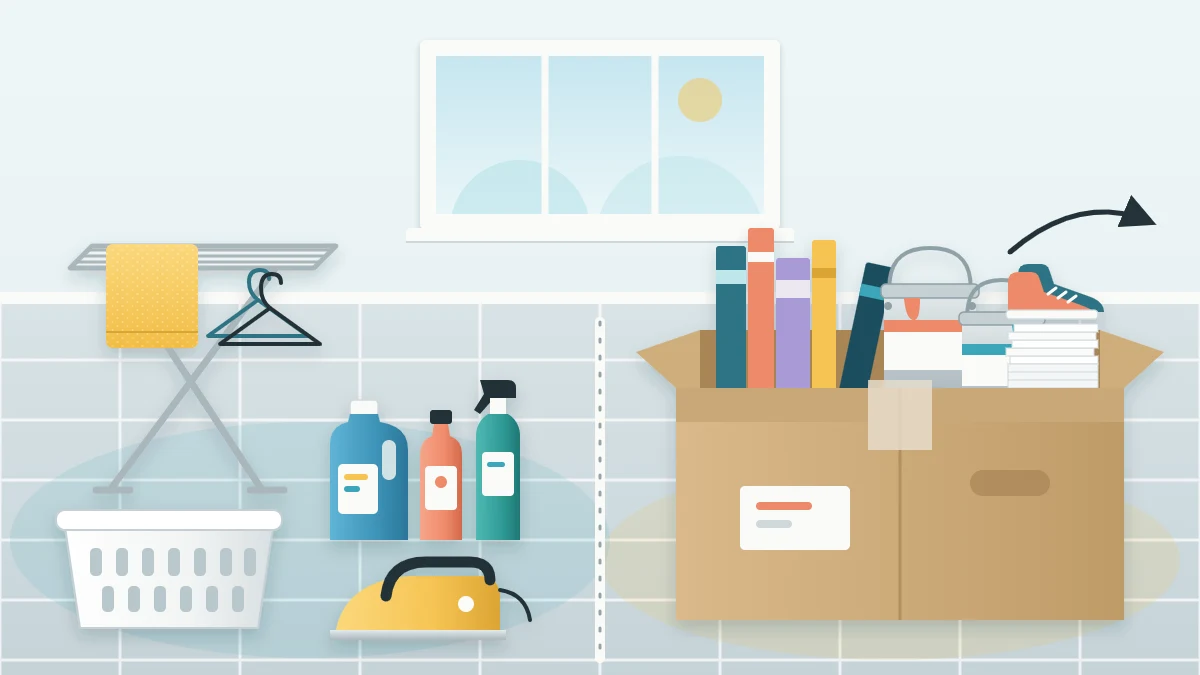
A laundry room tends to become the place where things go when nobody knows where else to put them. Deciding what to keep in a laundry room, and what to send elsewhere, is the step that makes every other organizing job smaller.
The three lists below sort the usual contents into keep, maybe and move out, with the reason for each. Treat them as a starting point and adjust for the size of your room and what else it has to do.
A quick test for any item
When you are unsure about something, ask three questions in this order:
- Is it used here? Things used in this room, during laundry, have the first claim on the space.
- Is it safe here? The room is warm, humid and shared with appliances. Some things spoil in those conditions, and some should not be near heat at all.
- Does it have a home here? If the only place for it is the top of the dryer or the floor, the answer is no.
An item that passes all three stays. An item that fails the first but passes the others is a “maybe”. An item that fails the second leaves, however convenient the spot is.
Keep: what the room is for
These are the things that earn their place in almost any laundry room:
- Laundry products in current use: the detergent, softener, bleach and other products you reach for every week, in their original labeled containers.
- Stain treatment items: your stain remover plus a soft brush and a few white cloths, kept together as a kit.
- Sorting containers: hampers or sorting bins, and the basket you carry laundry in.
- Drying equipment: a drying rack, a hanging rod or rail, clothespins.
- Ironing equipment: the iron, the ironing board or pressing mat, a pressing cloth.
- A small mending kit: needles, thread, safety pins, spare buttons and scissors.
- Everyday accessories: a lint roller, mesh bags, dryer balls and a supply of hangers.
- A bin for lint and trash, emptied regularly so lint does not build up.
- A few cleaning cloths for wiping the machines, the counter and the shelves.
What unites this list is frequency. Every item on it is handled during an ordinary week of laundry, so it deserves a spot within easy reach, grouped with the task it serves.
Maybe: when the room doubles as a utility room
Many laundry rooms also serve as the household’s utility space. If yours does, and there is room left over once the laundry items are placed, these can stay:
- Household cleaning supplies, in their original containers, stored up high or in a closed, latched cabinet like the laundry products.
- The vacuum, mop, broom and bucket, hung or parked where they do not block the machines.
- Back-stock paper goods, such as paper towels and tissue, on a dry upper shelf.
- Pet supplies: leashes, towels, grooming tools and sealed food containers.
The condition is that each group gets its own zone. Cleaning supplies do not drift onto the laundry shelf, and the pet towels do not live in the clean-laundry basket. When groups blur, the room starts to feel full even if it holds very little.
In a utility room, storage also has to stay clear of the electrical panel, the water heater and the furnace. Layout ideas for shared rooms are in the guide to utility room storage.
Move out: what does not belong
Things that suffer from humidity and warmth
Paper documents, photographs, books and cardboard keepsake boxes absorb moisture and can warp or go musty. Some medicines and cosmetics are also sensitive to warmth and damp; store them as their labels say, which often means another room.
Food that is not sealed
Open bags of pet food, pantry overflow and anything in thin packaging pick up smells and moisture, and attract pests. Food that must be stored here belongs in sealed packaging, well away from laundry and cleaning products.
Flammable items and anything the label says to keep from heat
Paint, solvents, aerosol cans, fuel and similar items should not sit beside a dryer, a water heater or a furnace. Read each label and store the product where and how it directs. If the label says to keep it away from heat or appliances, the laundry room is the wrong place.
Anything piled on or around the machines
Stacks on the washer, boxes pushed against the dryer and bags wedged behind the machines get in the way of doors, controls, hoses and the vent connection. Clear them, and keep free whatever space the appliance manual asks for.
Long-term clutter
Seasonal decorations, sports gear, tools, outgrown clothes and things waiting to be returned or donated have no connection to laundry. They need a home in a closet, the garage or a storage area, or they need to leave the house.
Good to know
The product label decides where a product may be stored, not the shelf that happens to be free. If a label’s storage directions do not suit a warm, humid room, find the product another home.
How much of each product to keep
Belonging in the room is not the same as belonging there in bulk. Keep amounts you will actually use: the container that is open, plus a spare or two as back-stock. More than that takes shelf space from things you use and makes it harder to see what you have.
Store every product as its label says, in its original container, with the cap or lid closed. In a home with children or pets, products go up high or in a closed, latched cabinet, out of reach and out of sight, and return there right after use. Placement, spares and bulk containers are covered in detail in the guide to laundry detergent storage.
If you find several half-used bottles of the same kind of product, do not pour them together. Use them up one at a time, or dispose of the ones you do not want as their labels direct.
Turning the lists into action
Lists are easy to agree with and harder to apply to a full room. The practical way is to take one shelf or surface at a time, hold each item against the three questions and move it straight to where it belongs.
The step-by-step guide on how to declutter a laundry room sets out that process, including what to do with products you no longer want.
Frequently asked questions
What should not be stored in a laundry room?
Move out things that dislike warmth and humidity, such as papers, photos and some medicines and cosmetics, along with unsealed food, flammable items and anything whose label says to keep it away from heat or appliances. Unrelated long-term clutter, like seasonal decorations and sports gear, also belongs elsewhere.
Can I store cleaning supplies in the laundry room?
Yes, if the room has space and doubles as a utility room. Keep household cleaning supplies in their original containers, in their own zone, up high or in a closed, latched cabinet out of reach of children and pets, and store each one as its label directs.
How much detergent should I keep on hand?
Keep the container in use plus a spare or two as back-stock. Larger stockpiles take up shelf space and make it harder to see what you have. Store each product in its original container as the label says, and finish one before opening the next.