
How to Build a Productive Daily Routine Without Losing Your Mind
Why a Productive Daily Routine Changes Everything
A productive daily routine is one of the most powerful tools you have for getting more done, feeling less stressed, and actually finishing your day with energy to spare.
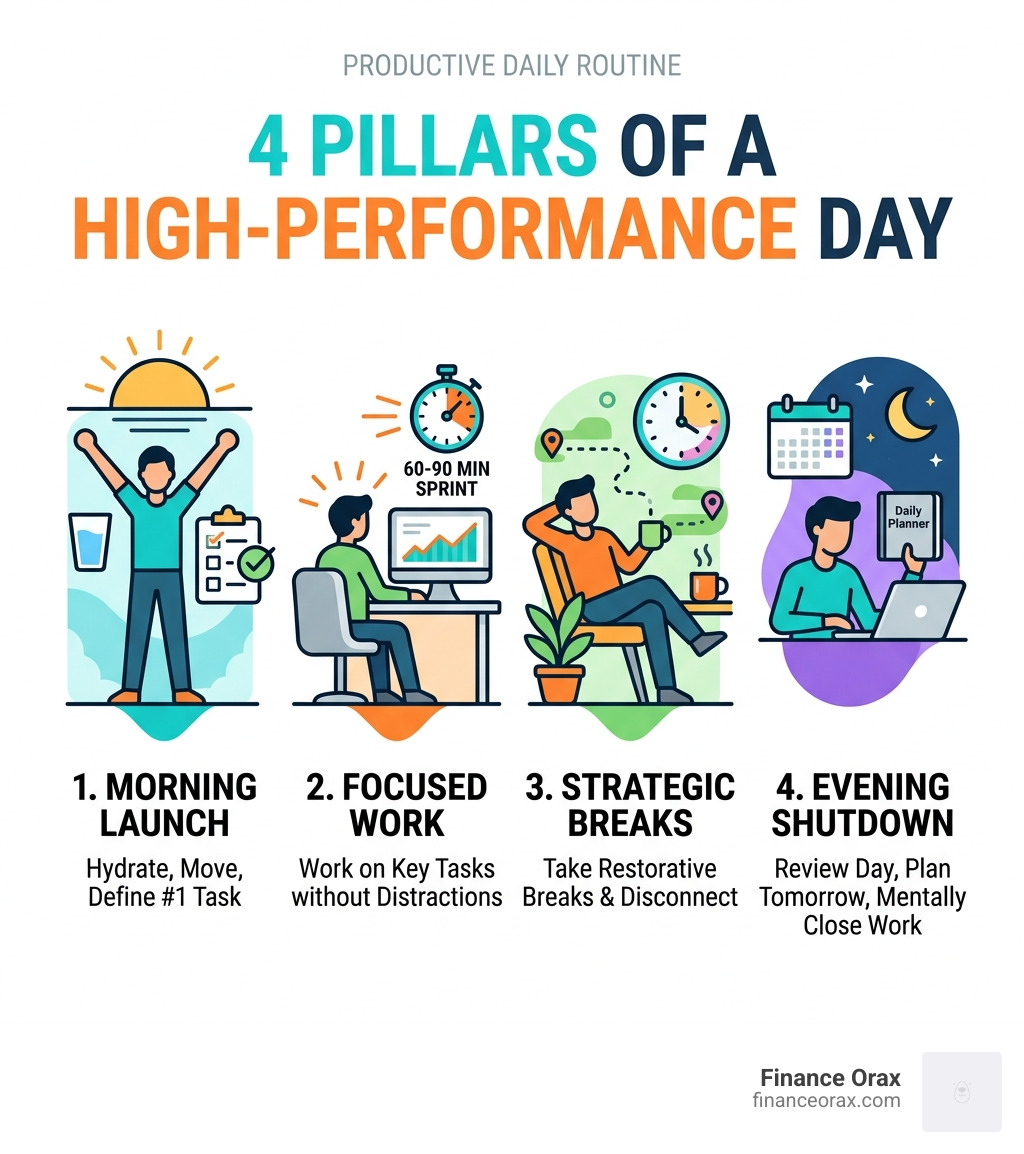
Here’s what a strong daily routine looks like at a glance:
- Morning Launch – Hydrate, move your body, and define your #1 task for the day
- Focused Work Blocks – Work in 60-90 minute sprints on your most important tasks
- Strategic Breaks – Take real, restorative breaks between work sessions
- Evening Shutdown – Review your day, plan tomorrow, and mentally close out work
Most people don’t have a routine problem. They have a structure problem.
Think about it: the average person makes around 35,000 decisions a day. Without a clear plan, you spend enormous mental energy just figuring out what to do next. That’s called decision fatigue — and it quietly kills your productivity before lunch.
The research backs this up. A full 90% of Americans say their morning routine sets the tone for their mental wellness throughout the entire day. Yet most people start their day reacting to emails, hitting snooze, and drifting into busyness rather than real work.
This guide is for busy professionals who want a routine that actually holds together — even when life gets hectic. You don’t need to wake up at 5 AM or follow some influencer’s rigid schedule. You need a flexible system built around your energy, your goals, and your real life.
Let’s build it.
The Science of a Productive Daily Routine

Building a productive daily routine isn’t just about willpower; it’s about biology. When we align our activities with our internal clocks, we stop fighting our bodies and start flowing with them. This alignment is rooted in our circadian rhythms—the 24-hour internal clock that cycles between sleepiness and alertness.
One of the most critical biological events is the Cortisol Awakening Response (CAR). In the first 30 to 45 minutes after you wake up, your body naturally spikes cortisol levels to help you feel alert. Research shows that morning light exposure can increase this cortisol boost by up to 50%. This doesn’t just wake you up; it sets a “timer” for your body to release melatonin roughly 14 hours later, ensuring better sleep.
Why does this matter for your output? Because people who maintain a consistent morning routine report 92% higher productivity compared to just 79% among those who wing it. Furthermore, shifting your wake time just one hour earlier has been associated with a 23% lower risk of major depression, according to 2021 data from JAMA Psychiatry.
We also have to consider neuroplasticity. Our brains are most “plastic” or ready to learn and form new habits during the morning hours. By using a Daily System for High Output, we can leverage these energy peaks to tackle complex tasks when our cognitive function is at its highest. Instead of forcing yourself to be a “5 AM Miracle Morning” person, we recommend focusing on your personal energy peaks—the times of day when you feel naturally most sharp.
Designing Your Morning Launch for High Output

The “Morning Launch” is about priming your brain and body. It isn’t a race; it’s a transition. If you dive straight into your phone, you’re immediately putting yourself in a reactive state, letting the world’s priorities dictate your mood.
Instead, we suggest starting with these science-backed habits:
- Hydrate Immediately: Even 1–2% dehydration can impair your attention, short-term memory, and reaction time. Drink a full glass of water before you even look at a coffee bean.
- Sunlight Exposure: Aim for 5–20 minutes of morning sun. This regulates your circadian rhythm and boosts that 50% cortisol response we mentioned earlier.
- Strategic Movement: You don’t need a grueling CrossFit session. Just 30 minutes of moderate-intensity morning exercise has been shown to improve decision-making and executive function throughout an eight-hour workday.
- Mindful Reading: Six minutes of reading can reduce stress levels by 68%. Whether it’s industry news or a novel, it wakes up your cognitive gears gently.
Why “Eat the Frog” is the Ultimate Productive Daily Routine Hack
The “Eat the Frog” technique, popularized by Brian Tracy and inspired by a Mark Twain quote, is simple: do your hardest, most important task (MIT) first thing in the morning.
Your “frog” is the task you’re most likely to procrastinate on, but it’s also the one that will move the needle most in your life or career. When you complete your MIT early, you create a sense of momentum that carries you through the rest of the day. It prevents that nagging “I still have to do that” feeling from draining your mental energy. By the time lunch rolls around, you’ve already won the day.
Tailoring Your Productive Daily Routine for Chronotypes
In April 2026, with 37% of jobs being performed entirely from home, we have more flexibility than ever to honor our “chronotypes.”
- Early Birds (Lions): Your peak energy is between 8 AM and 12 PM. Schedule your “deep work” and “frogs” early. Use your afternoon for meetings and admin.
- Night Owls (Wolves): You might feel sluggish until 11 AM. Don’t fight it. Use your morning for “shallow work” (emails, chores) and schedule your high-intensity focus blocks for the late afternoon or evening when your brain finally wakes up.
The goal isn’t to be a morning person; it’s to be a productive person. If your peak energy is at 7 PM, that is when your productive daily routine should center its most demanding tasks.
Optimizing Work Hours with Energy Management
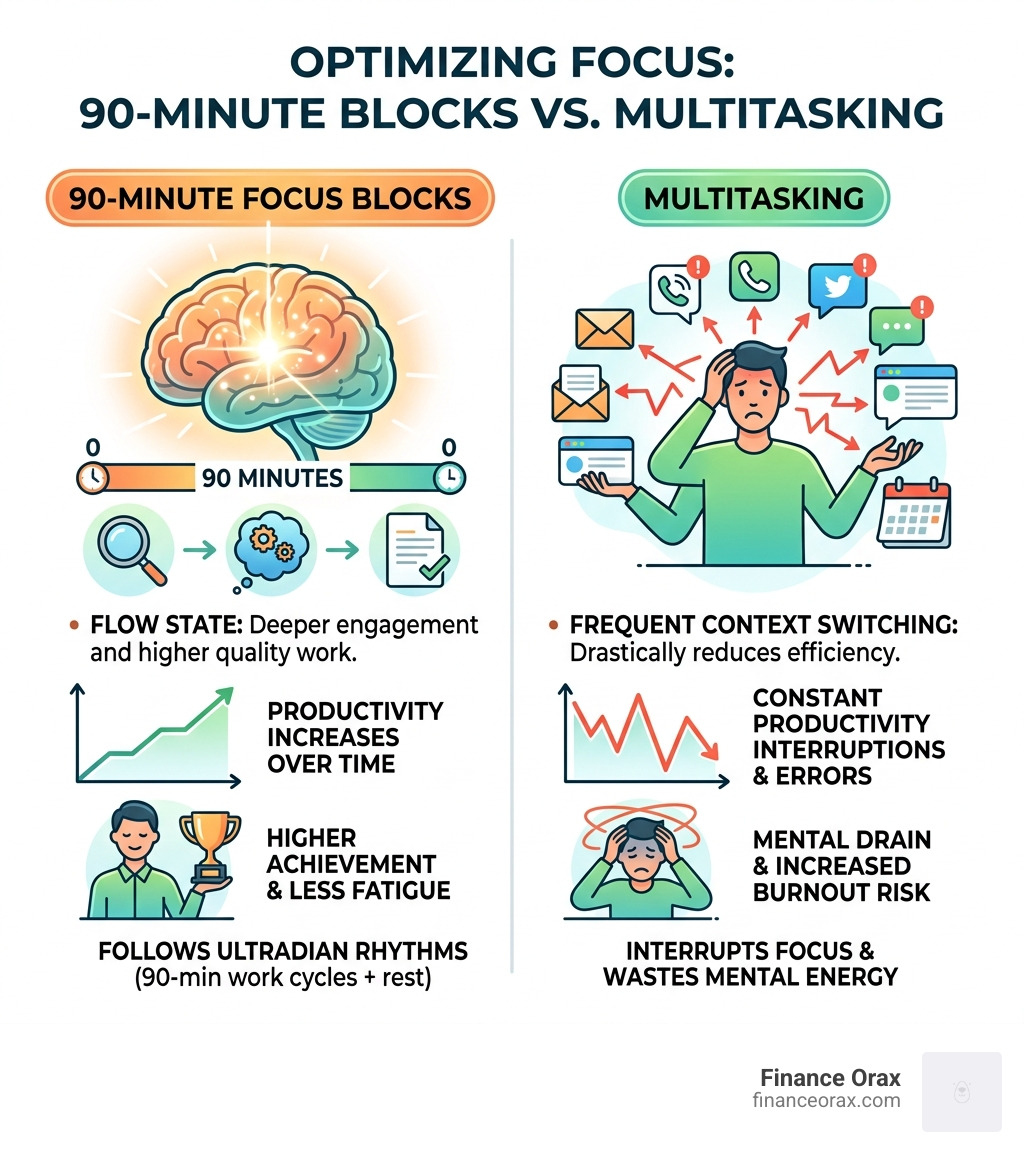
Traditional time management tells you to fill every minute. Energy management tells you to protect your focus. Our brains work in ultradian rhythms—cycles of high-frequency brain activity (about 90 minutes) followed by a 15-20 minute dip in energy.
If you try to grind for four hours straight, your work quality will suffer. Instead, we recommend using structured work sprints:
- The Pomodoro Technique: 25 minutes of work followed by a 5-minute break.
- The 52-17 Rule: 52 minutes of intense focus followed by 17 minutes of rest. This was found to be the “golden ratio” for the most productive employees in several tracking studies.
| Task Type | Examples | Best Energy State |
|---|---|---|
| Deep Work | Writing, Coding, Strategy, Analysis | High Energy / Peak Hours |
| Shallow Work | Emails, Data Entry, Scheduling | Low Energy / Slump Hours |
| Recovery | Stretching, Walking, Meditation | Energy Dips / Breaks |
Taking strategic breaks is not “wasting time.” It is the only way to avoid burnout. With the average American commute sitting at 25.4 minutes (for those who still go to an office), remote workers can repurpose that time into a “midday reset”—a walk or a short nap to clear the mental cobwebs.
The Evening Shutdown and Sleep Hygiene
Your productive daily routine for tomorrow actually starts tonight. If you don’t have a plan for the next day, you’ll wake up in a state of “decision paralysis.”
A Shutdown Ritual is a 10-15 minute process where you:
- Review what you accomplished (celebrate the wins!).
- Write down your “Big 3” priorities for tomorrow.
- Clear your physical and digital workspace.
- Say “Workday done” out loud to signal to your brain that it can stop processing work problems.
This is crucial because 35.2% of all adults in the U.S. report seven or fewer hours of sleep per night. Poor sleep is the ultimate productivity killer. To protect your rest, implement a “No-Tech Hour” before bed. Blue light from screens suppresses melatonin, making it harder to fall asleep. Instead, try a gratitude practice or six minutes of fiction reading to lower your heart rate and prepare for deep recovery.
Habits to Avoid in Your Productive Daily Routine
To maximize your output, you must eliminate “negative routines” that form without conscious effort:
- The Snooze Button: This leads to fragmented sleep and “sleep inertia,” making you feel groggy for hours.
- Morning Phone Checking: This puts you in a “reactive” rather than “proactive” mindset.
- Information Junk Food: Consuming outrage-heavy news or endless social media scrolls drains your mental battery before you’ve used it for anything meaningful.
- Skipping Breakfast or Hydration: Your brain needs fuel. Even a protein-rich snack can prevent the 2 PM slump.
Building Habits That Stick
At Finance Orax, we believe that your environment is the silent architect of your habits. If your desk is cluttered, your mind will be too. If your office lighting is dim and yellow, you’ll feel tired.
To make a productive daily routine stick, use these strategies:
- Habit Stacking: Attach a new habit to an old one. “After I pour my morning coffee (old habit), I will write down my MIT (new habit).”
- The 66-Day Rule: While pop psychology says it takes 21 days to form a habit, research shows the average is actually 66 days for a behavior to become automatic. Don’t give up in week three!
- Environment Design: This is our specialty. Use 5000K LED lights in your office to mimic daylight and keep cortisol levels optimal. Keep your vision board or goal list within eyesight of your desk to maintain motivation. Use peppermint or lemon essential oils to trigger alertness through scent.
We provide the tools and decor ideas to build better daily routines because we know that a well-designed space reduces the friction of getting started. When your “setup” is ready and waiting for you, you don’t need willpower—you just need to show up.
Frequently Asked Questions about Daily Routines
How can I structure a productive daily routine while working remotely?
The key to remote productivity is creating “boundaries.” Since more than 50% of people worked from home during the pandemic peak, we’ve learned that without a commute, work-life lines blur. Structure your day with “bookends”—a clear morning routine to start and a shutdown ritual to end. Use physical cues, like changing out of pajamas or sitting at a dedicated “work-only” desk, to tell your brain it’s time to perform.
What is the 20/20/20 rule for a morning routine?
The 20/20/20 rule is a 60-minute framework for a balanced morning:
- 20 Minutes of Movement: Sweating or stretching to wake up the body.
- 20 Minutes of Reflection: Journaling, meditation, or planning to center the mind.
- 20 Minutes of Growth: Reading, listening to a podcast, or studying your industry to expand your worldview.
How long does it take for a new routine to become automatic?
As mentioned, it takes an average of 66 days. However, this can range from 18 to 254 days depending on the complexity of the habit. The most important thing is consistency, not perfection. If you miss a day, just get back on track the next morning.
Conclusion
Building a productive daily routine isn’t about becoming a robot. It’s about creating a “flexible operating system” that supports your highest goals while protecting your mental health. By understanding your biology, managing your energy rather than just your time, and designing an environment that encourages focus, you can achieve high output without losing your mind.
Start small. Pick one “anchor habit” today—maybe it’s drinking water before coffee or planning your day the night before. Once that feels automatic, stack another one on top.
Ready to transform your workspace into a productivity powerhouse? Start building your productive daily routine with Finance Orax and discover how the right setup can make high performance feel effortless.
