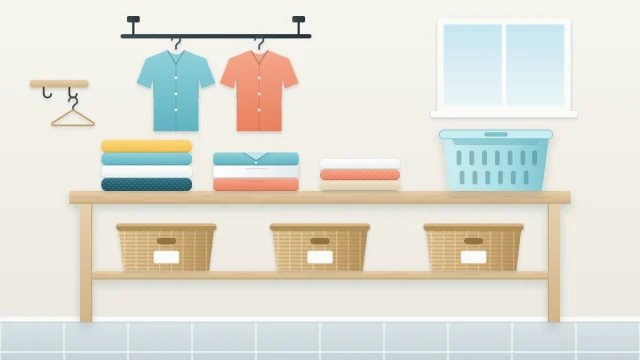
Laundry Sorting System: Baskets, Hampers and Dividers
Set up a sorting system that matches how your household washes: choose the categories, pick a container for each, size it to one load and mark it so everyone uses it.

A heap of mixed laundry turns wash day into two jobs: first the sorting, then the washing. A laundry sorting system moves the first job to the moment clothes come off, so that by the time a container is full, a load is already waiting.
The system itself is simple. You decide which categories your household really washes, give each one a container of about one load, and mark the containers so nobody has to guess. The rest of this page covers the choices in that order.
Start with the categories you really wash
There is no universal list. A household that washes everything in two loads a week needs two containers, and one with sports kit, work clothes and a baby may need five. Look at the loads you ran over the last couple of weeks and write down what they were.
Common categories include:
- Lights and whites
- Darks and colors
- Towels and bedding
- Delicates or anything that goes on a special cycle
- Heavily soiled items such as sports or work clothes
The care label sewn into each garment decides what can be washed with what, so treat this list as a starting point and not a rule. If a category fills only once a month, it does not earn a full-size container: a small bag on a hook is enough.
Choose a container type for each category
Once you know the number of categories, pick the hardware that fits the floor and wall space you have. Mixing two types is fine, as long as each category has one obvious home.
| Type | Space it uses | Suits |
|---|---|---|
| Divided hamper or sorter on a frame | One strip of floor | Two to four everyday categories in one spot |
| Separate baskets on a shelf or under a counter | Shelf or under-counter space | Rooms with a folding counter; easy to carry one basket at a time |
| Rolling sorter cart | Floor space plus a parking spot | Rooms where the sorter has to move out of the way |
| Wall-hung bags | Wall or door only | Narrow rooms and small, light categories |
| Pull-out bins in a cabinet | A base cabinet | Shared rooms where laundry should be out of sight |
Wall-hung bags and rails carry more than they appear to once the bags fill. Use hooks or rails with a stated load rating that covers a full bag, follow the fixing instructions for your wall type, and check for pipes and cables before drilling, because laundry room walls often contain both. A rolling cart should park where it does not block the appliance doors or the path to the controls.
For where empty and full baskets live between loads, see the guide to laundry basket storage.
Size each container to one load
The most useful sizing rule is that one container roughly equals one load in your washer. When the container is full, the load is ready: no counting, no topping it off with strays from another pile, no half loads.
To find the size, load your washer with dry clothes to the level the appliance manual describes for a normal load, then tip that load into the basket or bag you are considering. It should fill the container without overflowing.
Towels and bedding are bulky, so that category usually wants the largest container. Delicates want the smallest.
Decide where the sorting happens
Sorting can happen in the laundry room or where clothes come off. Both work; the right one depends on your space and on who is doing the sorting.
Sorting in the laundry room
Everyone brings dirty laundry to one place and drops it into the right container. This needs floor or wall space near the machines. Place the sorter on the route in from the door, before the washer, so dirty laundry never crosses the clean side of the room. The article on laundry room zones explains that layout in more detail.
Sorting where clothes come off
In a small laundry room or a closet, put a divided hamper in each bedroom or bathroom and bring one category at a time to the machine in a carry basket. The laundry room then only has to hold the load in progress. This version works best when each hamper uses the same categories in the same order.
Add the small extras that catch the exceptions
Most sorting systems fail on the items that fit no container. A few small additions deal with them:
- A mesh bag on a hook for socks, small items and anything that would otherwise vanish in a load.
- A spot for items that need stain treatment, such as a small basket or a hook near the sink, so they are not washed and dried by accident before you have dealt with them.
- A small jar or dish for pocket finds: coins, hair ties, receipts and screws.
- A hook or clip for odd socks waiting for their partners.
Mark the containers so everyone uses them
A system only one person understands is still a one-person job. Mark each container in a way the whole household can read at a glance:
- Color: a light bag for lights and a dark bag for darks needs no explanation.
- Icons: a simple towel or shirt symbol on a clip-on tag works for young children and guests.
- Words: a plain tag on the frame or basket handle, placed where it stays visible when the container is full.
Keep damp items from sitting
Damp towels, washcloths and gym clothes are the one category that cannot wait in a closed container. Choose breathable sorters for them: open-weave baskets, mesh or fabric bags, or bins with ventilation holes. Solid lidded bins hold moisture in.
Do not leave wet towels piled in a hamper. Hang them over a rail or the side of the basket until they are dry enough to drop in, or wash them soon. A hook or short rail next to the sorter makes this the easy option.
Good to know
The care label on a garment and the appliance manual decide how items are washed. The sorting system only makes it easier to follow them.
Connect sorting to the rest of the room
Sorting is the first half of the loop; getting clean laundry out again is the second. If clean loads currently pile up on a chair, a laundry folding station is the natural next step.
Give the new system two weeks before you judge it. If one container always overflows while another stays empty, change the categories, not the household.
Frequently asked questions
How many laundry sorting categories do I need?
As many as the kinds of loads you run in a normal fortnight, and no more. Many households manage with three or four: lights, darks, towels and bedding, and a small one for delicates. Garment care labels decide what can be washed together, so adjust the list to your own clothes.
Is a divided hamper better than separate baskets?
A divided hamper keeps several categories in one strip of floor and suits a fixed spot. Separate baskets take more shelf or floor space but can be carried to the washer one at a time. Choose by where the containers will stand and how far the laundry has to travel.
Can damp towels go in a laundry sorter?
Only for a short time and only in a breathable container such as a mesh bag or open-weave basket. Hang wet towels until they are dry enough to drop in, or wash them soon. Piled damp fabric in a closed bin tends to smell musty.