Laundry Basket Storage: Where Baskets Go When Not in Use
Empty baskets become clutter when there are too many and none has a home. Count what you need, pick a storage spot that fits them, and set a simple route so they come back.

Empty baskets are awkward things. They are bulky, they do not stack unless they match, and they have a habit of settling in the hallway, on the dryer or in the middle of the floor. Good laundry basket storage fixes that with two decisions: how many baskets the household really uses, and one assigned slot for each of them.
Neither decision calls for a remodel. Most rooms already have a spot that works once the baskets are counted and the right kind of holder is chosen for it.
Why baskets turn into clutter
Baskets pile up for two reasons. The first is number: an extra one is bought for a busy week and never leaves. The second is that a basket spends most of its life in transit, so nobody thinks of it as having a home. It is dropped wherever the last armful of clothes was put away.
A hamper that collects dirty laundry in a bedroom is different. It stays put. The trouble comes from carry baskets, the ones that move between rooms, so those are the ones to plan for.
Count what your household needs
A common pattern is one carry basket per person, or one per floor of the home. Treat that as a starting point and adjust it to how you do laundry. A household that washes everything together on one day may want more than a household that runs a small load every evening.
Line up every basket you own and ask which ones were used in the last two weeks. Cracked baskets, odd sizes that fit nowhere and spares “just in case” can go. If your sorting is done in fixed hampers or a divided sorter, you may need fewer carry baskets than you think; the guide to setting up a laundry sorting system covers that side.
Places to store empty baskets
Cubbies or a shelf under a counter
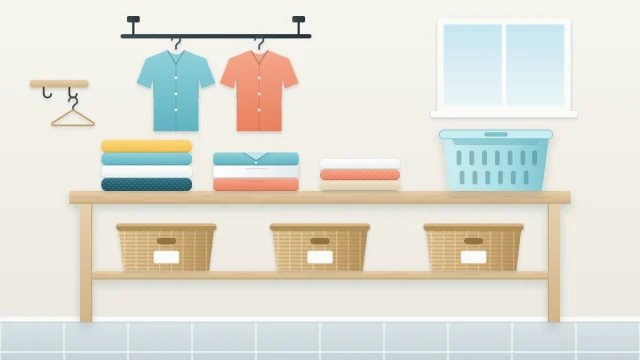
Open cubbies sized to the baskets are the tidiest answer. Each basket slides in like a drawer and comes out with one hand. Measure the basket first, then allow a little room on each side and above so it does not catch. Many rectangular baskets are about 24 in (60 cm) wide, but check yours before you build or buy.
A shelf above the machines
A wall shelf over the washer and dryer can hold light, empty baskets that are not needed every day. Use a stable step stool to reach it, never climbing or standing on a machine or counter, and follow the shelf’s fixing instructions and stated load rating.
Wall brackets or large hooks
Brackets or wide hooks hold a basket by its rim or handle, flat against the wall. This suits a narrow room where floor space matters most. Check for pipes and cables before drilling, since laundry walls often hide both, and see the wider guide to laundry room wall storage for rail and hook options.
Nesting stacks
Baskets of one type nest inside each other and take up the footprint of a single basket. A nested stack fits on the floor at the end of a counter, in a corner or on a low shelf.
Collapsible baskets that hang
Baskets that fold flat can hang on a hook or slide beside a cabinet. They are useful in a very small space, such as a hallway laundry closet, where a rigid basket has nowhere to sit. The article on laundry closet organization shows how they fit into that kind of layout.
A basket tower
A tall frame with rails lets several baskets slide in one above the other. It turns a small patch of floor into storage for three or four. Secure a tall freestanding unit against tipping with the restraint supplied or an anti-tip kit, following its instructions.
Under a hanging rod
The floor beneath a hanging rod is often empty when shirts are short. A basket or two can sit there as long as hanging clothes do not drag across them.
Options compared
| Storage spot | Suits | Check first |
|---|---|---|
| Cubbies under a counter | Rigid baskets used every week | Basket width, depth and height |
| Shelf above the machines | Light, empty spares | Shelf load rating and safe reach |
| Wall brackets or hooks | Narrow rooms | Wall type, pipes and cables |
| Nested stack | Matching baskets | That they separate easily |
| Hanging collapsible baskets | Closets and tight corners | Hook size and door swing |
| Basket tower | Several baskets, little floor | Anti-tip restraint |
Choosing baskets that store well
If you are replacing baskets anyway, pick ones that make storage easy:
- One model. Matching baskets nest, stack and fit the same cubby. Mismatched ones do none of those things.
- Real handles. Handles or a firm rim make a basket easier to carry and to hang.
- Ventilated sides. Openings let air move through damp items waiting to be hung up.
- A size that fits. Measure the shelf or cubby and the narrowest doorway on the route. A basket that scrapes the door frame will be left in the hall.
- Easy to wipe. Smooth surfaces clean quickly when lint and dust build up.
Tip
Before buying a set, take one basket home and try it in the slot and through the doorways. It is much easier to return one than four.
Keep baskets off and away from the machines
The top of the dryer is the most tempting basket shelf in the house. Resist it as a storage spot. A basket left on top of or pushed against a washer or dryer can block a door, a lid, the controls or the airflow the appliance manual asks you to keep free.
The floor in front of the machines matters too. A basket parked there has to be moved before every load, and it is the one people trip over. Keep the working space clear and give the basket a slot to one side.
Good to know
Before using any machine top as a surface, even briefly for folding, check the appliance manual. Some tops are not meant to carry anything.
A simple circuit so baskets come back
Storage only works if baskets return to it. A short, fixed route does that better than reminders:
- Clean laundry leaves the room in its basket and goes straight to the bedroom.
- Clothes are put away from the basket, not left sitting in it.
- The empty basket comes back to its slot the same day.
If baskets stall in bedrooms, look at step two. A basket used as a second dresser never comes back, and the fix is drawer space, not another basket.
Frequently asked questions
How many laundry baskets does a household need?
A common pattern is one carry basket per person or one per floor, but the right number depends on how you do laundry. Count the baskets used in the last two weeks and let go of cracked ones, odd sizes and spares that never leave the stack.
Can I keep laundry baskets on top of the dryer?
It is better not to. A basket left on or pushed against a washer or dryer can block doors, controls or the airflow the appliance manual asks you to keep free. Check the manual before using a machine top for anything, and give baskets a slot of their own.
What kind of laundry basket is easiest to store?
Baskets of one model are easiest because they nest and fit the same shelf or cubby. Look for firm handles or a rim that can hang on a hook, ventilated sides, and a size that fits your storage spot and passes through your narrowest doorway. Collapsible baskets suit very small spaces.