Laundry Supply Baskets, Bins and Caddies: What to Use for What
Which basket, bin, tray, caddy or turntable suits which laundry items, how to size containers to a shelf, and why products stay in their original labeled packaging inside them.
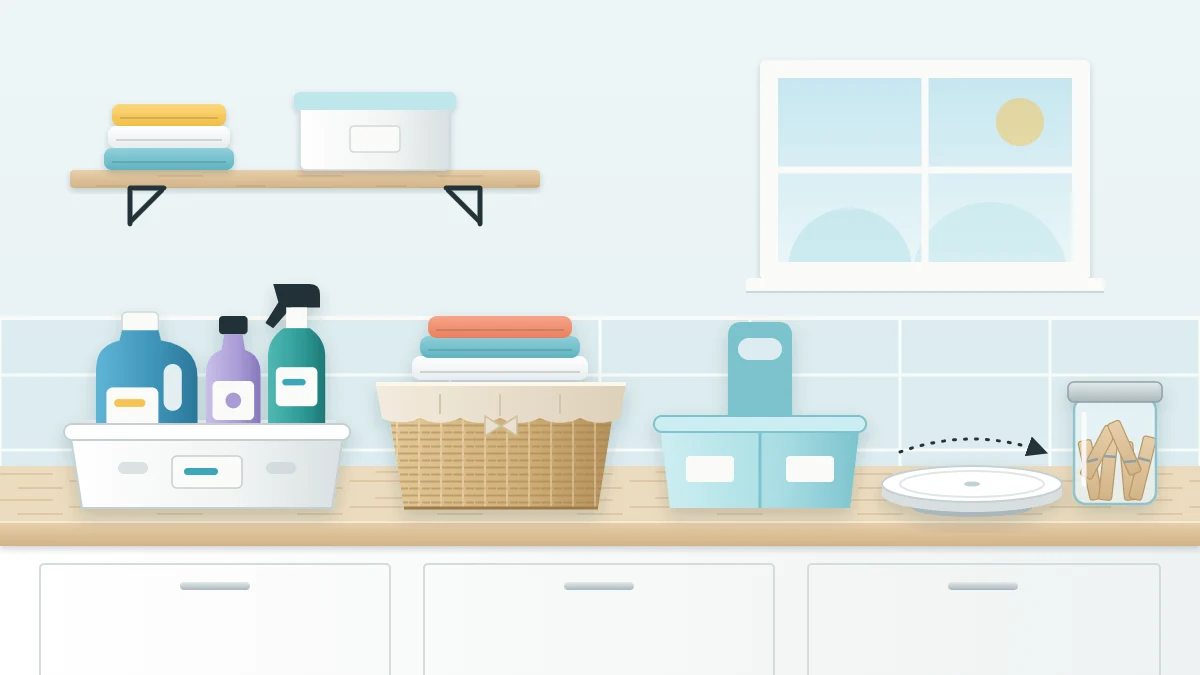
Containers are what turn a shelf of loose items into a shelf you can use with one hand. But laundry supply baskets, bins, trays and caddies each do a different job, and the wrong choice just hides the mess in a nicer shape.
One distinction comes first. These organizers are for grouping things, including laundry products that stay in their original labeled containers. They are not replacements for a product’s own packaging.
Grouping, not repackaging
A bin holds three bottles so they come off the shelf together. A tray keeps them in one place and catches drips. Neither changes what the product is stored in.
Do not move detergent, bleach, softener, packets or any other laundry product into jars, canisters or dispensers that are not their own. The product name, the directions, the warnings and the emergency information are all on the original label, and they need to stay with the product for as long as it is in your home. Detergent packets in particular stay in their original closed container.
Which container does which job
Open plastic or metal bins
These are the most useful all-round choice. They wipe clean, do not mind damp, and are the right thing to put under bottles of liquid. Choose straight sides over sloped ones, because sloped sides waste shelf width.
Woven baskets with liners
Baskets suit soft items and accessories: cleaning cloths, mesh bags, a set of dryer balls. A removable fabric liner stops snagging and can go in the wash. They are a poor match for anything that may leak.
Lidded boxes
A lid keeps dust and lint off things you rarely touch. Use lidded boxes for back-stock of non-hazardous items such as spare cloths, sponges, lint roller refills and light bulbs. A lid also means you cannot see inside, so each box needs a tag.
Trays
A shallow tray groups the bottles in current use and catches the ring that forms under a dripping cap. It also marks a boundary: when the tray is full, the shelf is full.
Handled caddies
A caddy is for a kit that travels: the stain kit that goes to the sink, or the ironing kit with a pressing cloth and a lint brush. Everything arrives together and returns together.
Turntables
A turntable brings the back of a deep cabinet to the front with one spin. It works best for upright bottles of similar height. Pick one with a raised rim so nothing slides off.
Wall cups and pockets
Small cups on a rail, or pockets on the wall, hold tools that get lost in a bin: scissors, a seam ripper, a fabric marker, a small brush.
Jars and small canisters
These are only for non-hazardous dry accessories such as clothespins, safety pins, buttons and dryer balls. They are never for detergent, packets, scent beads or any other laundry product.
Quick guide: best for, avoid for
| Container | Best for | Avoid for |
|---|---|---|
| Open plastic or metal bin | Bottles in their original packaging, everyday supplies | Tiny loose items that sink to the bottom |
| Lined woven basket | Cloths, mesh bags, soft accessories | Anything that may leak or drip |
| Lidded box | Back-stock of non-hazardous items | Things used with every load |
| Tray | Grouping bottles, catching drips | Tall stacks or loose small items |
| Handled caddy | Stain kit, ironing kit | Long-term back-stock |
| Turntable | Upright bottles in a deep cabinet | Boxes and odd shapes that jam |
| Small jar or canister | Clothespins, safety pins, buttons, dryer balls | Every kind of laundry product |
Size containers to the shelf
Buy containers after measuring, not before. Three numbers matter:
- Shelf depth. A bin should sit fully on the shelf without overhanging. On a shelf about 12 in (30 cm) deep, look for bins slightly shallower than that.
- Clear height. Measure from the shelf to the underside of the one above, then subtract enough for your hand. Around 2 in (5 cm) of finger room lets you lift a bin out without tilting it.
- Usable width. Measure between the cabinet sides or shelf brackets, not the outside of the cabinet, and allow for hinges.
Also measure your tallest bottle. A bin whose sides come about halfway up a bottle holds it steady while leaving the label readable. For arranging the filled bins by height and frequency of use, see the guide on how to organize laundry room shelves.
Materials that suit a damp room
Laundry rooms are humid, and containers live close to drips and lint. Plastic and coated metal are the least trouble: they wipe clean and do not absorb moisture. Bare wire lets small items fall through unless you add a liner.
Natural woven baskets are fine on a dry upper shelf with a liner, but can mark or go musty if they sit on a wet surface. Fabric bins are light and safe to pull down from a height, though they sag when overfilled and should be washable. Cardboard softens in damp air and is best kept for short-term use.
Whatever the material, remember that liquids are heavy. A bin of full bottles on a high shelf must be within the shelf’s stated load rating and light enough for you to lift down comfortably from a stable step stool.
How many containers you need
Fewer, larger groups beat many tiny containers. Every extra container is one more thing to lift, open and put back, and a shelf of twelve small boxes is harder to use than a shelf of four clear groups.
Sort your supplies into groups first, then count the groups. The method for forming those groups is in the guide on how to organize laundry supplies. Most rooms need only a handful: washing, stain treatment, drying and ironing, cleaning cloths and back-stock.
Finish with a tag on each container so everyone in the household can return things to the right place; ideas for wording and placement are in the guide to laundry room labels. Bin tags describe the group. They never replace the manufacturer’s label on a product.
Where filled containers should live
A container makes things easier to carry, which also makes them easier for a child to pull down. Any bin, tray or caddy that holds laundry products belongs up high or in a closed, latched cabinet, out of reach and out of sight. A basket lid or a latch is a help, not a substitute for putting products away right after use.
Accessories can sit lower, in open bins at hand height, where you can grab them without opening a door.
Frequently asked questions
Can I keep detergent packets in a basket on the shelf?
Yes, as long as they are still in their original closed container, which carries the product name, directions and warnings. Do not tip the packets loose into a basket or a jar. The closed container can sit inside a bin to keep a shelf tidy, up high or in a closed, latched cabinet, out of reach and out of sight of children.
What size bins fit laundry room shelves?
It depends on the shelf, so measure depth, usable width and the clear height to the shelf above. Choose bins slightly shallower than the shelf so they do not overhang, and leave a little finger room above them so a bin can be lifted out without tilting.
Are wicker baskets a good idea in a laundry room?
They work well for soft, dry items such as cloths, mesh bags and dryer balls, especially with a washable liner. They are a poor choice under bottles or anywhere that gets wet, because natural fibers can stain and turn musty. Plastic or coated metal bins are easier to wipe clean.