Laundry Room Labels: A Simple Labeling System for Shelves and Bins
A plain labeling system for laundry shelves, bins, baskets and hampers: what to name, which tag formats survive humidity, where to place them, and why product labels are never covered or replaced.
At a glance
What you need
- Clip-on bin tags
- Moisture-resistant adhesive labels
- Hang tags with string
- Shelf-edge strips
- Label maker or permanent marker
- Clean cloth for wiping surfaces
A shelf can be perfectly arranged and still fail, because only one person in the house knows the arrangement. Laundry room labels fix that. They tell everyone where the mesh bags live, which hamper takes towels and which bin holds the spare hangers, so things are found and put back without asking.
A good system is small and plain. It uses a handful of names the household already says, one style of tag and a few sensible places to put them.
First, the boundary: what these labels are for
The labels in this guide go on shelves, bins, baskets, hampers and drawers. They describe a place. They never replace the label a manufacturer puts on a product.
Detergent, bleach, softener, stain remover and every other laundry product stay in their original containers, with the manufacturer’s label visible and uncovered. That label carries the product name, the directions, the warnings and the emergency information, and all of it has to stay with the product. Do not stick a tag over it, and never re-label a different container as a product. Your tag goes on the shelf edge or on the bin that holds the original containers.
Good to know
A bin tag that says “detergent” tells people where the bottle lives. How to use and store the product is still decided by the label on the bottle itself, so keep that label facing forward and readable.
Sort and contain before you label
Labels come last. If you label a shelf that is still being rearranged, you will be peeling tags off within a week.
Finish the earlier work first: remove what does not belong, group what remains and give each group a container or a stretch of shelf. The guides on how to organize laundry room shelves and on choosing baskets and bins for laundry supplies cover those steps. When the layout has stayed the same for a week or two, it is ready for names.
Write the names in household words
List every group that needs a label, then choose its name. The right name is the word people in your home already use, not the most accurate one.
- Keep names to one or two words: “Mesh bags”, “Cloths”, “Hangers”, “Lost socks”.
- Name the group, not each item. One tag for “Accessories” beats five tiny tags.
- Avoid vague names such as “Misc” or “Other”. A bin with that name fills with everything.
- Use the same word everywhere. If the hamper says “Towels”, the shelf for clean ones says “Towels” too.
Choose a format that survives humidity
Laundry rooms are warm and damp, and paper stickers tend to curl. Pick a format that suits each surface:
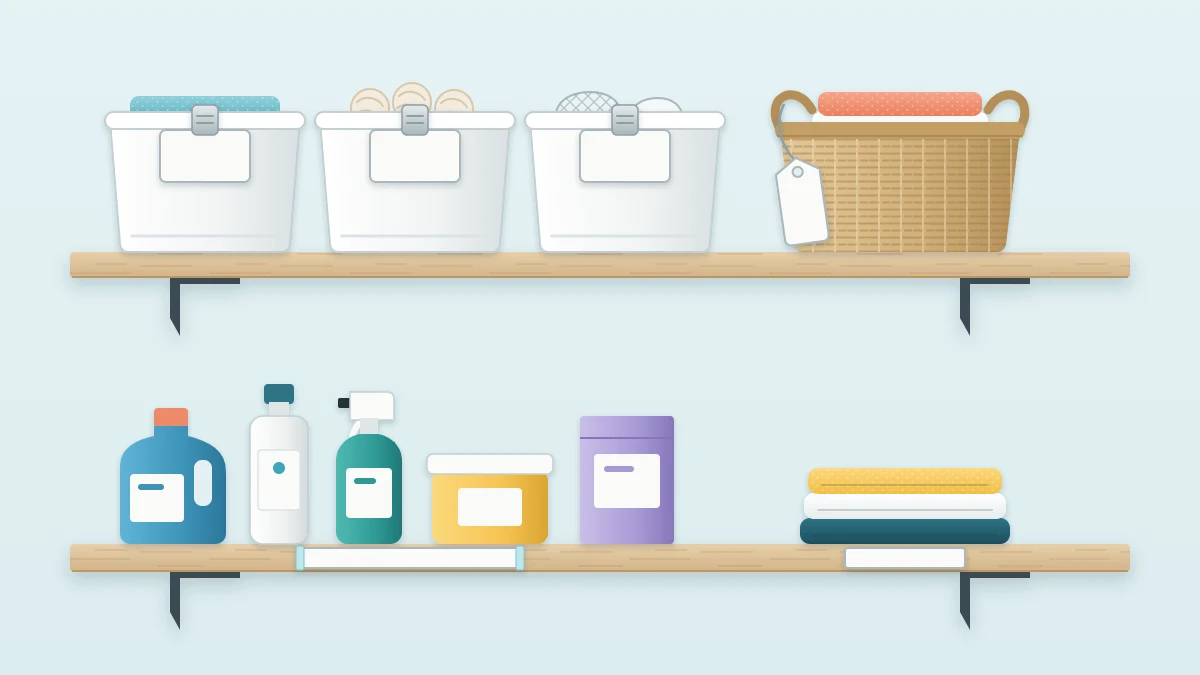
- Clip-on bin tags: clip to the rim of fabric, wire or woven bins where nothing sticks well. Easy to move.
- Adhesive labels: for smooth plastic or metal bins. Clean and dry the surface first, and choose a moisture-resistant type.
- Hang tags: tie to a basket handle or a hamper frame.
- Shelf-edge strips: sit on the front edge of a shelf, below a group, so the items themselves need no tag.

The wording can be printed with a label maker, handwritten with a permanent marker or replaced by a simple icon. Icons help young children and anyone who does not read the household’s language well: a drawn sock or towel is understood at a glance.
Then keep to one style and one size throughout the room. The same tag shape, the same lettering and the same color make labels easy to spot, and a mix of styles looks like more clutter.
Place labels where the eye lands
A label that has to be searched for does not get read. A few placement rules do most of the work:
- Put bin tags at the front center of each bin, at the same height along a shelf.
- For items standing loose on a shelf, put a strip on the shelf edge directly below the group.
- On high shelves, place the tag low on the bin so it can be read from below.
- On drawers, label the front, not the inside.
- Label only what faces the room. The back of a deep shelf does not need a tag.
The shelf-edge strip is the right choice for the row of laundry products. The strip names the zone, and each product keeps its own label in full view above it.
Label the sorting hampers
Sorting is where labels save the most time, because it is the job most people in the home take part in. Give each hamper or section of a sorter a tag with the category your household sorts by, in the words you use: for example “Lights”, “Darks” and “Towels”.
Which categories to use depends on how you wash, and the care labels in the clothes have the final say on any single item. If the categories are still unsettled, set up the laundry sorting system first and label it once it has run for a few weeks. Hang tags or clip-on tags suit fabric hampers; for children’s hampers, add an icon or a color.
Add a routine card if it helps
Some households like one small reference card inside a cabinet door. It might list the laundry-day routine in four or five lines, show who is responsible for which day or carry a chart of the common care symbols found on clothing tags.
Keep the card to things about the room and the routine. It is not a place to write your own product directions, since those are on each product’s label and should be read there.
Review after a month and keep labels removable
After about a month, look at how the labels are doing. The signs are easy to read:
- A bin that always holds something other than its name has the wrong name, or the wrong location.
- A label nobody follows may be unclear, too small or in a place people do not look.
- A tag that is peeling is the wrong format for that surface.
Rename, move or replace as needed. The label is there to describe what people do, so change the label before you try to change the people.
Removable formats make this easy. Clip-on tags, hang tags and low-tack adhesive labels come off without marks, which suits renters and bins that change use from season to season. Keep a few blank tags and the marker in a drawer in the room, so a new bin gets its name the day it arrives.
Frequently asked questions
What should I label in a laundry room?
Label the places, not the products: shelves, bins, baskets, hampers and drawer fronts. Name each group in one or two words the household already uses. Laundry products keep the manufacturer's label, in their original containers, and a tag on the shelf edge or bin shows where they live.
Which labels hold up in a humid laundry room?
Clip-on tags and hang tags are the most reliable, because they do not depend on adhesive. For smooth plastic or metal bins, choose moisture-resistant adhesive labels and apply them to a clean, dry surface. Test one for a week before labeling the whole set.
Can I put my own label over a detergent bottle's label?
No. The manufacturer's label carries the product name, directions, warnings and emergency information, and it has to stay visible and readable. Do not cover it or replace it. Put your organizing tag on the shelf edge or on the bin that holds the bottle instead.