
Stop Working from Your Bed with These Daily Home Office Routines
Why Your Daily Routine Home Office Determines Whether You Actually Get Work Done
A solid daily routine home office isn’t just a nice-to-have — it’s the difference between a productive day and one that disappears into a blur of half-finished tasks and endless distractions.
Here’s a quick look at what an effective WFH daily routine includes:
- Wake up consistently — same time every day, no snoozing into chaos
- Avoid screens first — skip the phone and news for at least 20–30 minutes
- Hydrate and eat — drink water immediately, follow with a protein-rich breakfast
- Move your body — even 10–15 minutes of movement sharpens focus for hours
- Set your top 3 tasks — identify your must-do priorities before opening email
- Work in focused blocks — protect deep work time with time blocks or the Pomodoro method
- Take real breaks — step away from the screen every 60–90 minutes
- Shut down intentionally — close tabs, reset your desk, and plan tomorrow before logging off
Most people who work from home assume flexibility will make things easier. It often does the opposite.
Without a commute, a boss walking past your desk, or a clear start time, the boundaries between work and life get blurry fast. You end up doing a little work, a little laundry, a little scrolling — and somehow nothing gets done.
Consider this: 46% of Americans check their phones before getting out of bed. And consuming content first thing in the morning makes you 27% more likely to report having a negative day. That’s a rough way to start a workday — especially when your office is ten steps from your bedroom.
The good news? A few intentional habits, applied consistently, can completely change how your days feel and what you actually accomplish.
This guide breaks down realistic, flexible WFH daily schedules you can actually stick to — whether you’re a night owl, a parent, or someone who just needs to stop working from their bed.
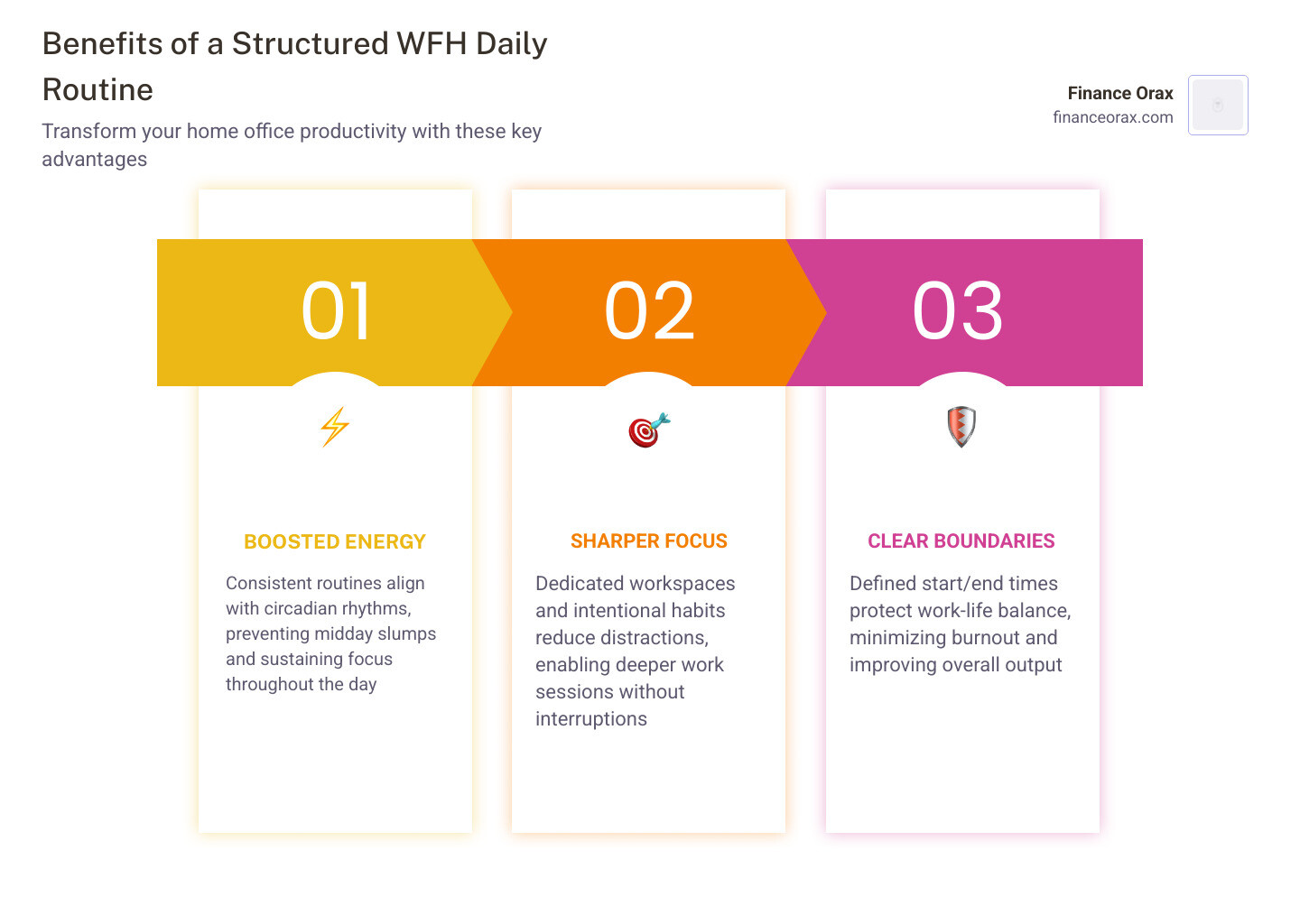
Designing Your Daily Routine Home Office Foundation
Before we talk about what time to drink your coffee, we need to talk about where you’re sitting. At Finance Orax, we believe your physical environment is the silent partner in your productivity. If your “office” is a pile of laundry on the corner of your bed, your brain is receiving signals of disorder before you even open your laptop.
A successful daily routine home office starts with workspace optimization. You don’t need a corner office with a mahogany desk, but you do need a dedicated spot that signals “work mode” to your brain. This is what experts call environmental cues. When you sit in that chair or turn on that specific desk lamp, your brain recognizes it’s time to focus.
Ergonomics are non-negotiable. Ever notice how the longer you sit in a bad chair, the less you feel your own butt? That’s your body’s way of saying it’s shutting down. To keep your energy up, ensure your monitor is at eye level and your feet are flat on the floor.
Science also tells us that your room’s “vibes” actually have a measurable impact on your output. Research suggests that office temperatures between 70–77°F (21–25°C) optimize sustained attention and reduce error rates. Furthermore, while total silence can be deafening, a 2012 study found that moderate ambient noise at around 65 dB—think the hum of a quiet coffee shop—actually enhances creative performance.
To truly structure your work-from-home day so you actually get things done, you must reduce friction. If you have to spend 15 minutes clearing off your desk every morning, you’re draining your “decision-making battery” before work even begins.

Eliminating Domestic Distractions
The biggest enemy of the home office isn’t the internet—it’s the pile of dishes in the sink. Domestic triggers are real. When you see a chore that needs doing, it creates a “micro-distraction” that pulls you out of deep work.
To combat this, we recommend:
- The “Daily Reset”: Clean your workspace the night before.
- Notification Management: Use “Do Not Disturb” modes on your phone and computer during focus blocks.
- Noise-Canceling Headphones: These are the universal “do not disturb” sign for remote workers.
- The “Closed Door” Policy: If you have a separate room, keep the door closed to signal you are “at the office.”
Setting Boundaries with Others
If you share your home with family or roommates, your daily routine home office is only as good as your communication. Without verbal boundaries, people assume that because you are home, you are available.
We suggest sharing your schedule digitally or hanging a simple physical signal (like a red ribbon on the door handle) to indicate when you are in a meeting. Establishing roommate etiquette—such as designated “quiet hours”—prevents the frustration of a loud blender going off during your most important client call.
The Ultimate Morning Routine for a Productive Daily Routine Home Office
How you start your morning determines the trajectory of your entire day. If you wake up and immediately check your email in bed, you are starting your day in a reactive state. You are letting other people’s priorities dictate your mental space.
Instead, strive for “screen-lite” habits. 46% of Americans check their phones before getting out of bed? Don’t be a statistic. Consuming stressful news or demanding emails first thing makes you 27% more likely to have a negative day.
Start with hydration. About 75% of Americans experience chronic dehydration, which leads to brain fog and fatigue. Drink a full glass of water before your first cup of coffee. Follow this with a balanced breakfast—think protein and fiber to avoid the mid-morning sugar crash.
Finally, utilize the time you used to spend commuting for movement. A 2019 study published in the British Journal of Sports Medicine found that morning exercise improves attention, visual learning, and decision-making. Whether it’s a 15-minute walk around the block or a quick yoga session, getting your blood flowing is the ultimate brain-booster.

Prioritizing Your Top 3 Tasks for a Productive Daily Routine Home Office
One of the most common pitfalls of remote work is the “infinite to-do list.” When you have 20 items on your list, your brain gets overwhelmed by decision fatigue and often chooses the easiest, least important task just to feel “busy.”
Instead, identify your Top 3 Tasks the night before or first thing in the morning.
- The Big Rock: Your most demanding, high-priority project.
- The Medium Task: Something important but less taxing.
- The Quick Win: A small task (under 30 minutes) to build momentum.
By focusing on just three outcomes, you protect your focus and ensure that even if the afternoon gets chaotic, you’ve moved the needle on what matters.
Reflection and Gratitude Practices
Productivity isn’t just about output; it’s about mindset. Incorporating a 5-minute reflection or gratitude practice can shift your brain from a “scarcity” mindset (I have too much to do) to an “abundance” mindset (I am capable of handling this).
Try asking yourself “Ritual Questions” each morning:
- What is the one thing that must happen today for me to feel successful?
- How do I want to feel at the end of this workday?
- What is one thing I’m grateful for in my career right now?
Managing the Midday Slump and Protecting Focus
Around 2:00 PM or 3:00 PM, most of us hit a wall. This isn’t laziness; it’s biology. Our bodies follow circadian rhythms, and a dip in energy in the early afternoon is perfectly natural. The key to a sustainable daily routine home office is working with your biology, not against it.
Nathaniel Kleitman, a pioneer in sleep research, discovered “ultradian rhythms”—90 to 120-minute cycles of high performance followed by a 20-minute recovery period. If you try to power through for four hours straight without a break, your productivity will plummet.
Strategic Breaks and Movement
Breaks are not “cheating”—they are performance enhancers. A study found that participants noted a 72% improvement in time management and workload completed on days when they exercised. Even if you can’t hit the gym, a “micro-break” can reset your focus.
Consider the 52/17 rule: Research from the Draugiem Group found that the most productive employees work for 52 minutes and then break for 17. Use those 17 minutes to:
- Do some desk stretches.
- Step outside for fresh air.
- Grab a protein-rich snack (like Greek yogurt or nuts).
- Hydrate again.
Handling the Afternoon Energy Dip
When the energy dip hits, don’t reach for a third cup of coffee—reach for light. Natural light exposure can help reset your internal clock and boost alertness. If you find yourself struggling with complex tasks, this is the perfect time to switch to “shallow work.”
Batch your administrative tasks—like answering non-urgent emails, filing expenses, or organizing your digital folders—for the afternoon when your cognitive load is lower. Save your “Deep Work” for your peak energy windows, which for most people is in the morning.
Sample Schedules and Tools for Remote Success
No two remote workers are the same. A parent’s daily routine home office will look vastly different from a night owl’s. The goal is consistency, not perfection.
| Feature | The Early Bird | The Night Owl | The WFH Parent |
|---|---|---|---|
| Start Time | 6:00 AM | 10:00 AM | 7:00 AM (Pre-school) |
| Deep Work | 7:00 AM – 10:00 AM | 8:00 PM – 11:00 PM | 9:00 AM – 12:00 PM |
| Admin/Meetings | 1:00 PM – 3:00 PM | 11:00 AM – 1:00 PM | 1:00 PM – 3:00 PM |
| Exercise | Midday Walk | Afternoon Gym | Morning Stretches |
| Hard Stop | 4:00 PM | 1:00 AM | 5:00 PM (Dinner) |
To keep these schedules on track, we recommend a few essential WFH apps:
- Time Trackers: Tools like Toggl help you see where your hours actually go.
- Focus Apps: Freedom or Forest can block distracting websites.
- Calendar Blocking: Use Google Calendar or Outlook to “claim” your focus time so others can’t book meetings over it.
- Pomodoro Timers: Simple web-based timers to keep your 52/17 or 25/5 rhythms.
Customizing Your Routine to Natural Rhythms
The beauty of working from home is the ability to honor your “chronotype.” If you know you are useless before 9:00 AM, don’t force a 5:00 AM wake-up call just because a “productivity guru” said so.
Use habit stacking to make your routine stick. This involves attaching a new habit to an existing one. For example: “After I pour my first cup of coffee (existing habit), I will write down my Top 3 Tasks (new habit).” This reduces the willpower needed to start your day.
Frequently Asked Questions about Daily Routine Home Office
How do I handle household interruptions during deep work? Communicate your schedule clearly to those you live with. Use physical cues like noise-canceling headphones or a closed door. If interruptions are inevitable (like kids), try to schedule your most “interruption-proof” tasks during those times.
How can I stay professionally visible while working remotely? Visibility is a common concern. Make an effort to “speak first” in meetings, send a Friday recap of your achievements to your manager, and contribute meaningfully to Slack or Teams threads rather than just using emojis.
What tax deductions can I claim for my home office? In many regions, if you use a portion of your home exclusively for work, you may be eligible for a home office deduction. This can include a portion of your rent, utilities, and internet. Always consult a tax professional to see what applies to your specific situation.
How do I prevent burnout when work and home are the same place? The “Shutdown Ritual” is your best friend. At the end of the day, physically close your laptop, clear your desk, and say out loud, “The workday is over.” This provides the psychological closure that a commute used to provide.
Conclusion
Building a daily routine home office is not about being a robot; it’s about creating a system that supports your best self. When you stop working from your bed and start working with intention, you reclaim your time, your energy, and your sanity.
At Finance Orax, we know that the right decor and a thoughtful setup are the foundations of these routines. By choosing furniture that supports your body and decor that inspires your mind, you make the “hard” parts of discipline a little bit easier.
Before you log off today, try the “Shutdown Ritual.” Spend five minutes clearing your desk and writing down your Top 3 Tasks for tomorrow. Your future self will thank you.
Looking for more ways to level up your space and your life? Discover more about our routine-building services and products at Finance Orax to turn your home office into a powerhouse of productivity.
