
How to Organize Home Office in 5 Easy Steps
A Cluttered Home Office Is Costing You More Than You Think
Home office organization is one of the fastest ways to reduce daily stress and get more done — without working longer hours.
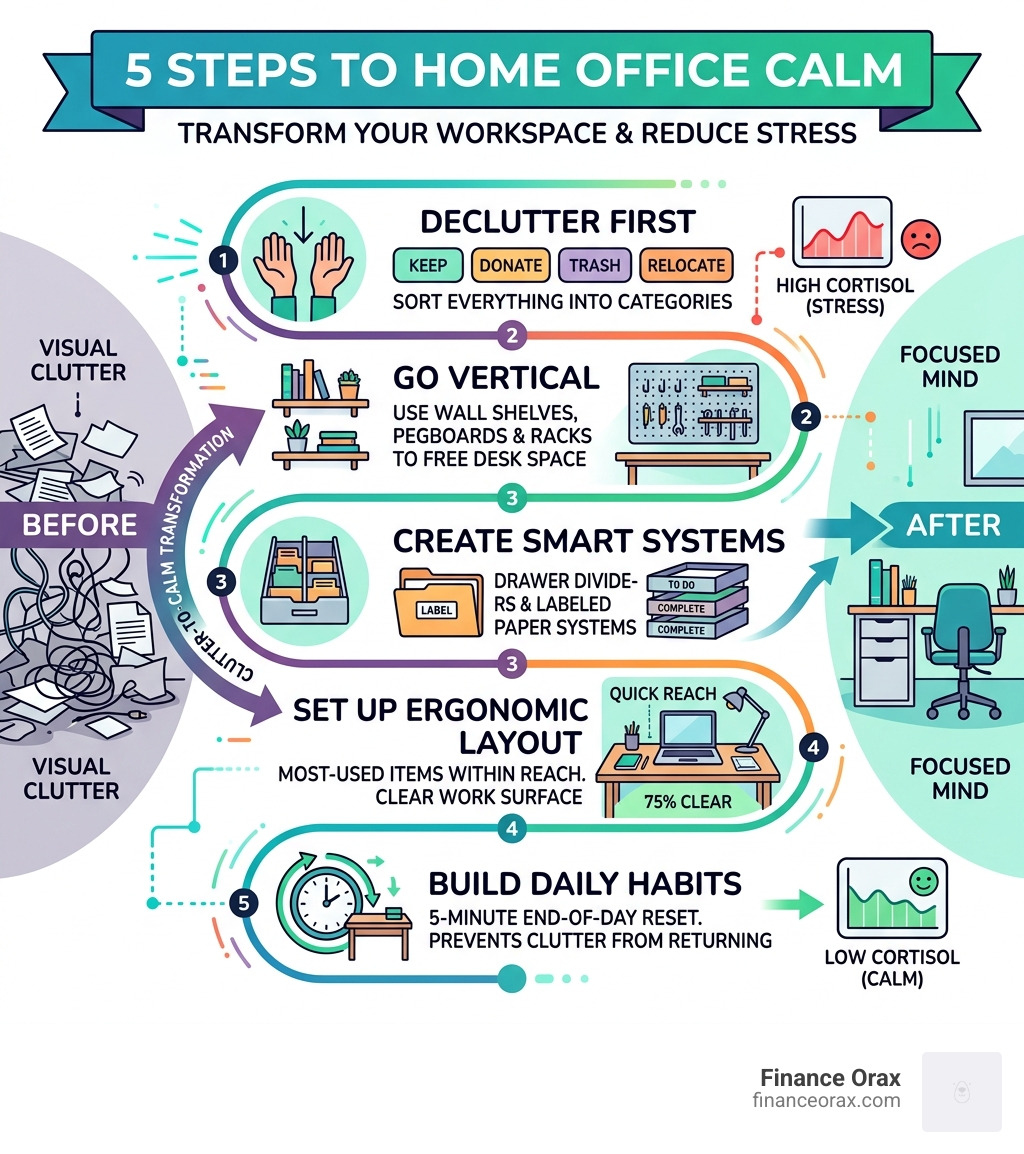
Here’s a quick overview of how to organize your home office in 5 steps:
- Declutter first — sort everything into Keep, Donate, Trash, or Relocate
- Go vertical — use wall shelves, pegboards, and mounted racks to free up desk space
- Create smart systems — organize supplies with drawer dividers, and manage paper with a labeled inbox system
- Set up an ergonomic layout — keep your most-used items within arm’s reach and your desk at least 75% clear
- Build daily habits — a 5-minute end-of-day reset prevents clutter from coming back
If your home office feels chaotic, you’re not alone — and the problem runs deeper than aesthetics.
Research shows that visual clutter directly raises cortisol, the body’s primary stress hormone. According to health experts at the Mayo Clinic, chronic stress can impact your overall well-being. That pile of papers you’re ignoring? Your brain isn’t ignoring it. It’s quietly draining your focus every hour you sit next to it.
For busy professionals already juggling packed schedules, a disorganized workspace adds invisible friction to every task. You waste time hunting for things. You feel overwhelmed before you’ve even started. And by the end of the day, you’re mentally exhausted — not just from the work, but from the environment.
The good news: you don’t need a full weekend or an expensive renovation to fix it. Small, intentional changes make a real difference.
Step 1: The Hard Edit and Decluttering Process
Before we buy a single pretty basket or a new desk, we have to talk about the “Hard Edit.” Most people make the mistake of buying organizers first and then trying to cram their existing clutter into them. This just results in “organized clutter”—fancy containers filled with things you don’t actually use.
Scientific research consistently shows that visual clutter competes for your attention. To reclaim your focus, you need to reduce the sheer volume of items in your room. We recommend starting with the Four-Box Method. Grab four large boxes and label them:
- Keep: Items you use every single day or at least once a week.
- Donate: Items that are still in good shape but no longer serve your current workflow.
- Trash/Recycle: Non-working pens, dried-up highlighters, and old manuals for tech you no longer own.
- Relocate: Items that belong in the kitchen, living room, or garage but have migrated to your desk.
For your paperwork, we suggest the System of Three:
- Shred/Toss: Expired coupons, old junk mail, and duplicate documents.
- File: Vital records, tax documents, and long-term reference materials.
- Take Action: Bills to pay or projects currently in progress.
The ultimate goal of this edit is what we call the 75% Clear Rule. Aim to keep at least 75% of your desk surface completely empty. A nearly empty desk isn’t just a minimalist dream; it’s a focused reality. When you remove the decision fatigue of looking at “to-do” piles, you build momentum. A storage problem is almost always a “too much stuff” problem.
Step 2: Maximizing Vertical Space for Home Office Organization
In a small office, the floor and desk are your most valuable real estate. If you’re drowning in supplies, it’s time to look up. Going vertical is like finding a secret storage room you didn’t know you had.
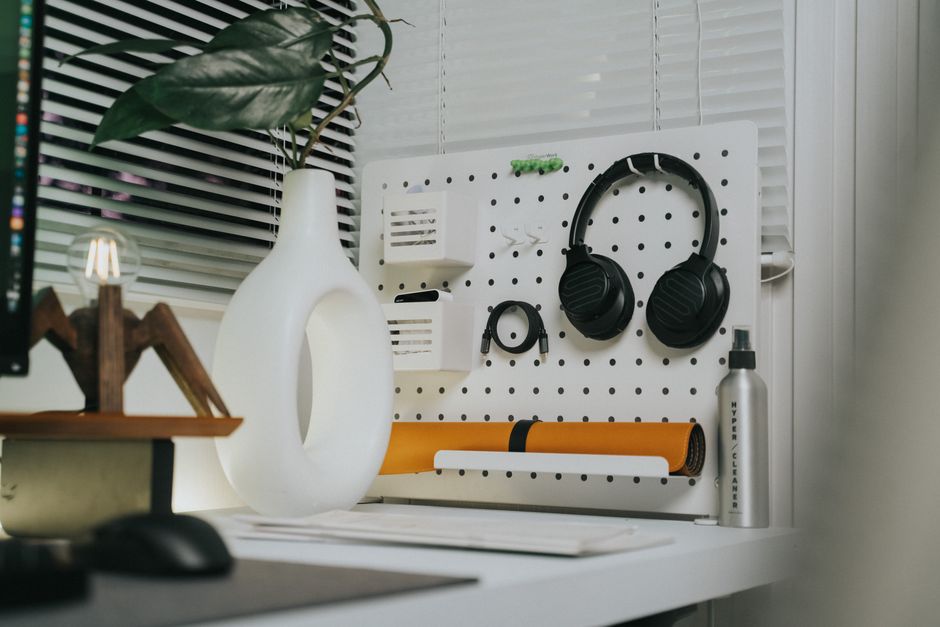
Pegboards are the unsung heroes of the modern home office. By mounting a pegboard, you can use modular bins and hooks to keep your scissors, tape, and headphones at eye level but off your desk. This reconfigurable system grows with you—if your hobbies change, you just move the hooks.
Floating shelves are another excellent way to utilize wall space. We like to mount them at eye level for frequently used reference books or labeled linen boxes. If you have a very tight space, consider wall-mounted racks or even a ladder desk that leans against the wall, providing multiple tiers of storage without a bulky footprint.
Don’t forget the “hidden” vertical spaces:
- Over-door organizers: Perfect for stashing extra office supplies like printer paper or mailing envelopes.
- Magnetic strips: Great for holding metal items like paperclips, scissors, or small tools.
- Vertical file sorters: Instead of stacking papers (which leads to the “paper monster”), stand them up. You’re less likely to lose a document if you can see the edge of the folder.
By moving items to the walls, you create a visual “threshold” between your work and the rest of the room, which is vital for mental health when working from home in April 2026.
Step 3: Implementing Smart Systems for Supplies and Paper
Once the clutter is gone and the walls are working for you, it’s time to organize the “guts” of your office: your drawers and your documents.
Managing Small Items and Home Office Organization
Chaos usually starts in the drawers. We’ve all had that “junk drawer” where pens, batteries, and loose clips go to die. To stop this, you must use drawer inserts or clear dividers.
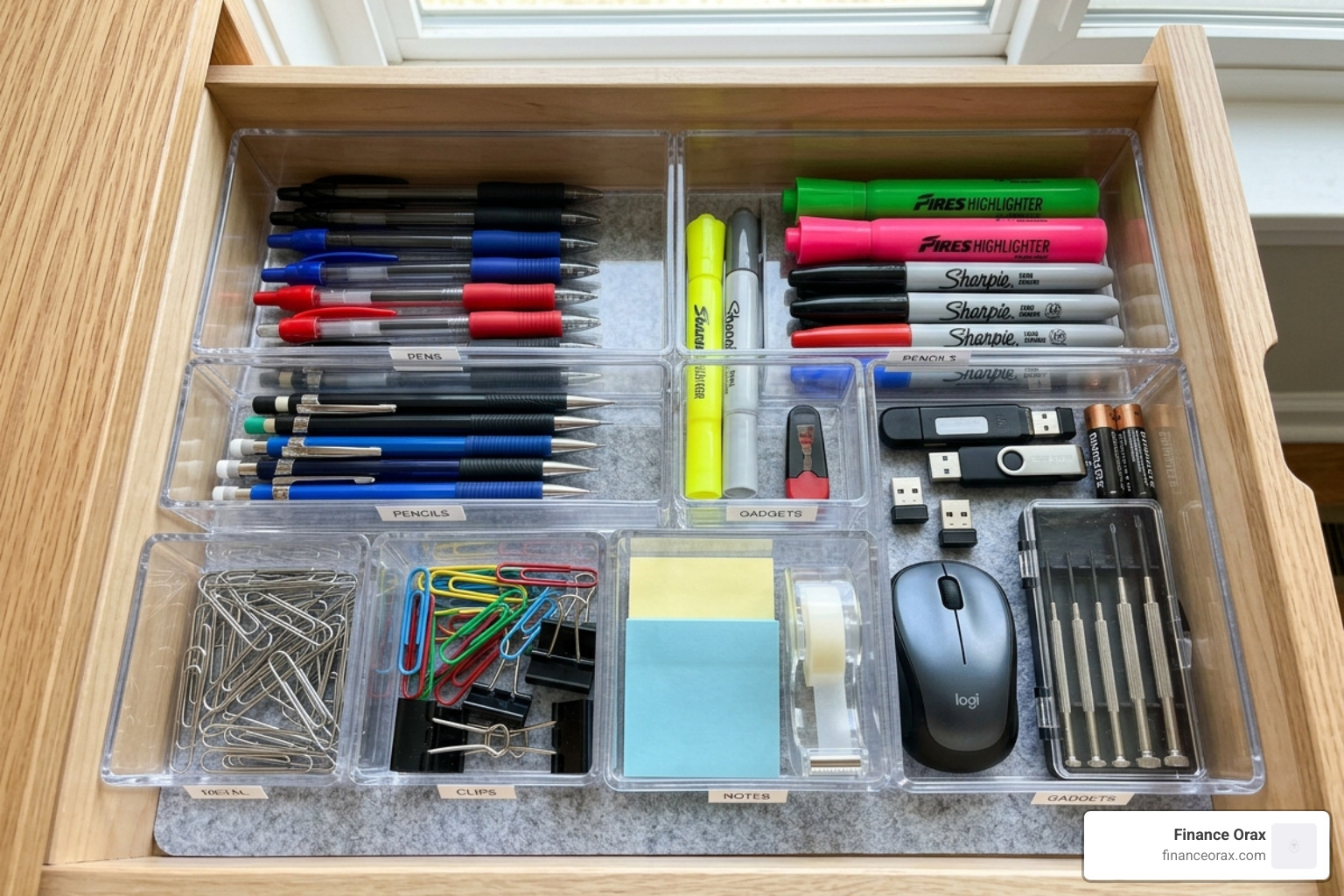
One of our favorite pro tips is using museum gel on the bottom of your drawer organizers. This prevents them from sliding around every time you open and close the drawer, keeping your perfectly sorted clips in place.
We also need to address the modern office’s biggest friction point: cables. A graveyard of charging cords makes any desk look messy. Use cable management trays under the desk to hide power strips, and use cord wraps or velcro ties to bundle cables together. Creating a dedicated tech docking station using a simple letter divider can keep your phone, tablet, and laptop charging in one neat spot.
Paper Management and Home Office Organization
Even in our digital world, paper has a mind of its own. To prevent “paper piles of doom,” we recommend a multiple inbox system. Instead of one catch-all basket, use three stacking trays labeled:
- Inbox: Everything new that hasn’t been looked at yet.
- Action: Items that require a response or a task this week.
- File: Items that are finished but need to be kept.
Process these trays within 48 hours to keep the flow moving. For long-term storage, color-coded folders are a game changer. For example, use green for finance, blue for clients, and red for urgent projects.
To truly master home office organization, embrace digital minimalism. Scan important documents into cloud storage and switch to paperless billing whenever possible. This reduces the physical footprint of your filing system and makes searching for a specific document as easy as typing a keyword.
Step 4 & 5: Ergonomic Layouts and Daily Maintenance Habits
Your desk layout should be designed around your body and your workflow, not just where the outlet happens to be.
| Feature | Modular Sit-Stand Desk | Fixed Traditional Desk |
|---|---|---|
| Ergonomics | Excellent; allows for movement and posture changes | Limited; requires a highly adjustable chair |
| Flexibility | High; adapts to different tasks and energy levels | Low; one height fits all |
| Storage | Usually minimal to allow for movement | Often includes built-in drawers |
| Productivity | Reduces fatigue and increases focus | Can lead to sedentary stiffness |
We recommend using a Zone System for your desk:
- The Hot Zone: The area within easy reach of both hands. This is for your computer, mouse, and your one favorite pen.
- The Warm Zone: Within arm’s reach. This is for your notepad, your water bottle, and your current project file.
- The Cold Zone: The edges of the desk or nearby shelves. This is for your printer, reference books, and decor.
Position your desk near a window for natural light, but try not to face it directly to avoid screen glare.
Finally, the most important part of home office organization is the maintenance. Getting organized is the easy part; staying organized is the habit. We suggest a 5-minute end-of-day reset. Every evening, clear your desk surface, file your papers, and put your pens away. This acts as a “mental clock-out,” signaling to your brain that the workday is over. More info about routine-building services can help you integrate these habits into your wider lifestyle.
Frequently Asked Questions about Home Office Organization
How do I organize a small office on a tight budget?
You don’t need a designer budget to have a productive space. Upcycling is your best friend. Use cleaned-out glass jars for pens, tin cans (wrapped in pretty paper) for rulers, and repurposed vanity trays for drawer dividers. You can even create a DIY clipboard wall for under $20 to keep active projects visible. Decluttering is free, and it’s the most effective organization tool you have!
What are the best ways to manage cable clutter?
Start with under-desk cable trays to lift power strips off the floor. Use adhesive cord clips to keep charging cables from falling behind the desk. Velcro ties are better than plastic zip ties because they are reusable and won’t damage the wires. If you can, switch to wireless peripherals like a Bluetooth mouse and keyboard to eliminate two extra cords immediately.
How often should I declutter my workspace?
We recommend a tiered approach:
- Daily: 5-minute desk reset.
- Weekly: 10-minute file purge (empty that “Action” tray!).
- Monthly: Supply check. Test your pens, empty the trash bin, and see if you’ve accumulated any “just in case” items that need to go.
- Seasonally: A deep clean of your tech and a review of your long-term filing system.
Conclusion
At Finance Orax, we believe that a better home office leads to a better life. By applying these five steps—the hard edit, vertical storage, smart systems, ergonomic layouts, and daily habits—you aren’t just cleaning a room; you’re building a routine that supports your mental health and professional growth.
Our holistic approach to routine-building focuses on how your physical environment impacts your daily success. Whether you are using a repurposed corner of your bedroom or a dedicated suite, your workspace should feel like a place where you want to spend time. Transform your home office routine today and see how much more you can achieve when the chaos is cleared away.
