Freestanding Laundry Shelving Units: Choosing and Placing One
The types of standing shelving for a laundry room, what to measure and look for before buying, where a unit can stand, and how to load and secure it so it stays steady.
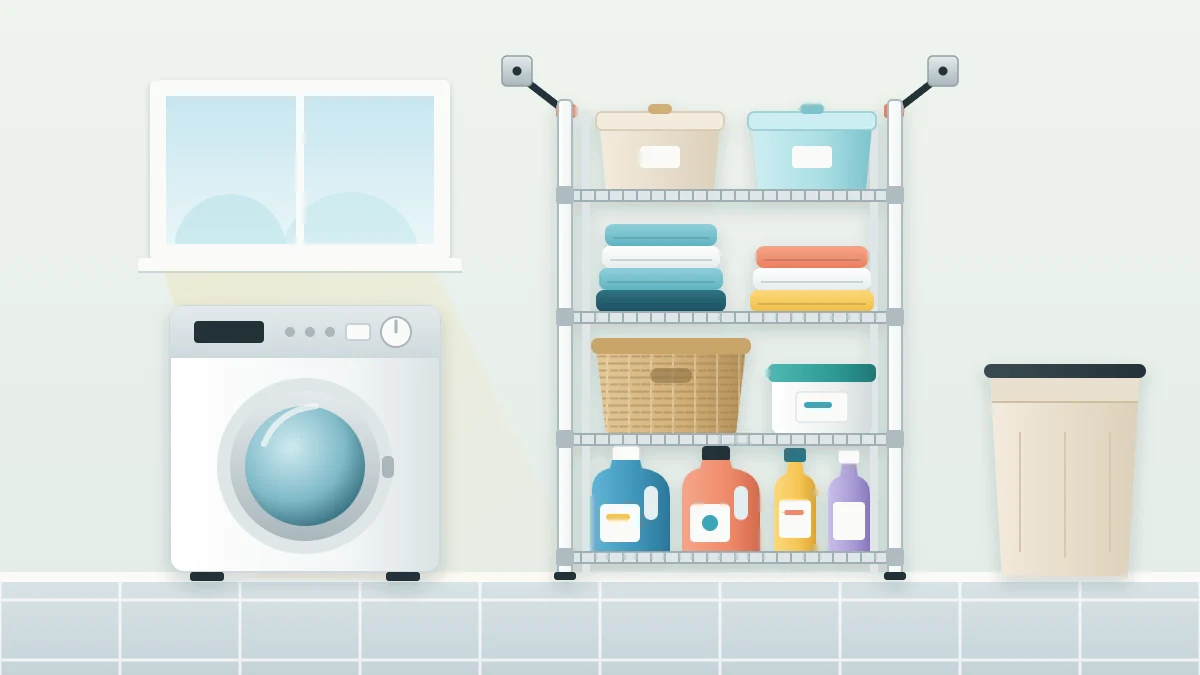
Not every wall can take a shelf. You may rent, the wall may be tiled or full of pipes, or you may simply want storage you can take with you. Freestanding laundry shelving solves all three: it stands on the floor, goes together with basic tools and can be rearranged when your needs change.
It does bring two questions that wall shelves do not: where it can stand without crowding the machines, and how to keep a tall unit from tipping. This guide covers the types, what to check before buying, and how to place and load a unit safely.
The main types of standing unit
- Wire or metal units with adjustable shelves: the workhorse. Shelves move up and down the posts, so the spacing can match your bottles and baskets.
- Over-the-washer frames: shelves on tall legs that stand astride a machine and use the space above it. They need extra checks, described below.
- Narrow tower units: slim and tall, for the strip of floor beside a machine or behind a door.
- Cube organizers: low, wide units with square openings that take fabric bins or folded towels.
- Ladder-style shelves: shelves that get shallower toward the top, for a lighter look. Many lean against the wall and are designed to be fastened to it.
- Rolling units: shelves on casters that pull out for cleaning. Look for wheels that lock.
If you are still deciding between standing and wall-mounted storage, the overview of laundry room shelving ideas compares both.
What to measure before you buy
Measure the room first, then shop to the numbers.
- Floor space. Measure the width and depth of the free floor, at the baseboard and again higher up, because pipes, valves and trim narrow the space.
- Height. Measure to the ceiling, and note anything lower: a window sill, a light fixture, a sloping ceiling, a wall cabinet.
- Door swings. Open the room door, the washer door, the dryer door and any cabinet doors fully, and mark how far each one reaches.
- What will go on it. Measure your tallest bottle and your widest basket. A shelf about 14 to 18 in (35 to 45 cm) deep takes most baskets; around 12 in (30 cm) is enough for bottles and folded towels.
Very tight rooms need a different approach to layout as a whole, which the guide to small laundry room organization covers.
Features worth paying for
- Adjustable shelves. Fixed spacing wastes height. Adjustable shelves let you set one tall space for bottles and several shorter ones.
- A finish that tolerates humidity. Laundry rooms are damp. Coated or plated metal and sealed surfaces cope better than raw wood or unsealed board, which can swell.
- Leveling feet. Laundry floors often slope toward a drain. Adjustable feet let the unit stand firm without wobbling.
- Open wire shelves. Lint falls through instead of settling, and air moves around what is stored.
- A stated load rating per shelf. You need it to load the unit sensibly, so choose a product that gives one.
- A tip-over restraint. Many tall units include one. If yours does not, plan to add an anti-tip kit.
Where to stand it
Good positions are beside the machines, on a free wall or in a corner. Wherever it goes, three rules apply.
First, do not push the unit hard against the washer or dryer. Machines move slightly as they run, and each one comes with its own instructions about the space around it. Leave whatever space the appliance manual asks for.
Second, never stand a unit in front of the dryer vent connection, the water shut-off valves, the hoses or the power connection. You need to see and reach those. In a shared utility room, the same goes for the electrical panel, the water heater and the furnace; there is more on that in the guide to utility room storage.
Third, check that every door still opens fully and that you can stand comfortably in front of the machines with a basket in your hands.
Over-the-washer frames: check the manual first
A frame that straddles a machine looks like free space, but it is the type that needs the most care. Before you buy one, read the appliance manual and confirm that the machine may sit inside such a frame with the space the manual asks for on every side and above.
Then check the practical points. A top-loader lid must open all the way under the lowest shelf. A front-loader door must swing clear of the legs. The controls, the detergent drawer and the lint filter must stay easy to reach, and the legs must not rest on or press against hoses, the vent connection or the power connection.
If the manual is unclear, ask the manufacturer before deciding. If the frame fails any of these checks, a tower unit beside the machine is the safer choice.
Loading the shelves so the unit stays steady
Liquids are heavy, and a shelf of full bottles weighs far more than it looks. Follow the unit’s stated load rating for each shelf, and remember that the rating assumes the unit was assembled as instructed, with the load spread evenly.
- Heavy things low: back-stock paper goods, a full basket, bulk packs of non-hazardous items.
- Everyday things in the middle: folded towels, cloths, accessories in open bins.
- Light things high: empty baskets, spare linens, light lidded bins.
Laundry products are the one conflict with the “heavy low” rule. In a home with children or pets they belong up high or in a closed, latched cabinet, out of reach and out of sight, in their original containers. If the unit cannot hold them high within its load rating, give them a cabinet instead of a low open shelf.
To reach the top shelf, use a stable step stool. Never climb the shelves or stand on a machine.
Secure tall units against tipping
Any tall freestanding unit can tip if it is pulled, climbed or loaded top-heavy. Fasten it to the wall with the tip-over restraint supplied, or with an anti-tip kit, and follow the kit’s instructions for your wall type. Check for pipes and cables before drilling, and ask a professional when unsure.
Good to know
A restraint reduces the risk of a tip-over; it does not make a unit safe to climb. For more detail on why and how furniture is secured, see the U.S. Consumer Product Safety Commission’s Anchor It campaign.
Frequently asked questions
Do freestanding shelves need to be anchored to the wall?
Tall units should be. Any tall freestanding unit can tip if it is pulled, climbed or loaded top-heavy. Use the tip-over restraint supplied with the unit or an anti-tip kit, and follow its instructions for your wall type. If you cannot drill, a low, wide unit is the more stable choice.
Can I put a shelving unit over my washer?
Only after checking the appliance manual. Confirm that the machine may sit inside a frame with the space the manual asks for, that the lid or door opens fully, and that the legs do not touch hoses or connections. If any of that is in doubt, use a tower unit beside the machine.
What type of shelving unit holds up best in a damp laundry room?
Coated or plated metal units with open wire shelves generally cope well with humidity, because air moves around them and lint falls through. Sealed wood or laminate can work if edges are well finished. Raw wood and unsealed board tend to swell and are better avoided in damp rooms.