Small Laundry Room Organization: Making a Tight Space Work
A strategy for very small laundry rooms: cut down what lives there, follow a clear priority order, build upward, use the door, pick pieces that fold or slide, and leave the machines the space their manual asks for.
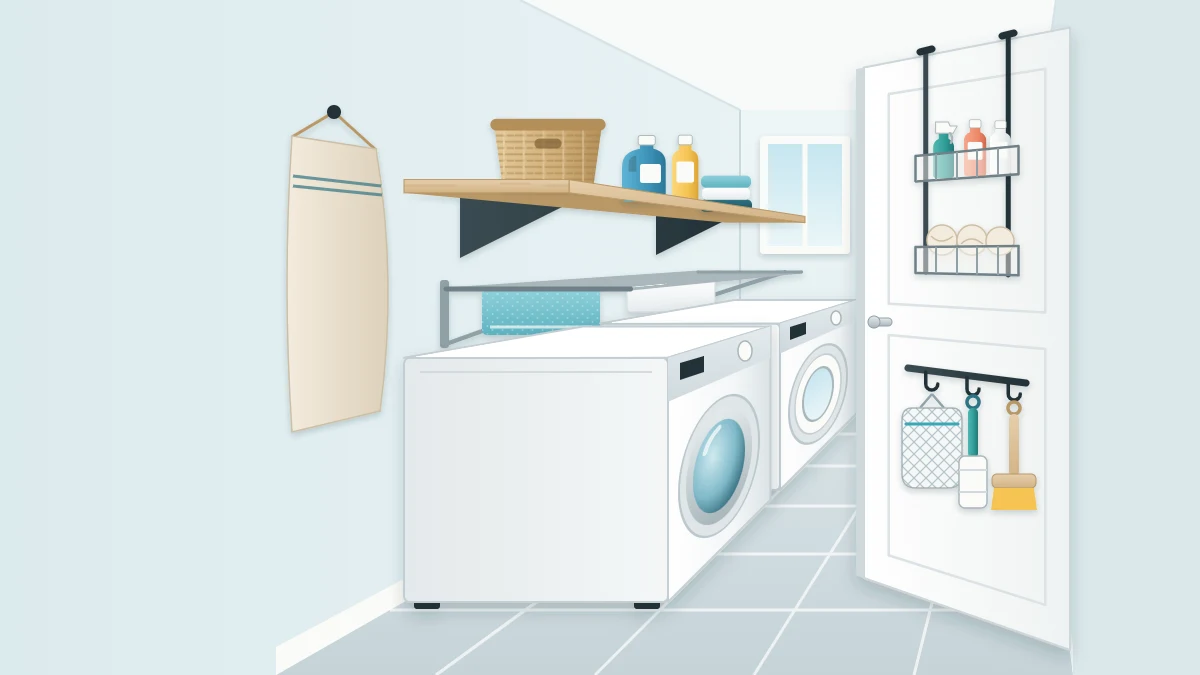
A very small laundry room can feel like it has no room to organize at all: two machines, a door that barely clears them and a strip of floor. Yet tight rooms often end up working better than large ones, because every decision has to be deliberate.
Small laundry room organization follows a different logic from a big room. You are not looking for more storage so much as fewer things, taller storage and pieces that get out of the way when they are not in use.
Reduce what lives in the room first
No arrangement can rescue a small room that holds too much, so start by taking things out. The test is simple: is it used for laundry, and is it used often?
- Only laundry things. Tools, pet supplies, bulk paper goods and seasonal items move to another closet.
- One of each product in use. Keep a single open container of each laundry product by the washer. Unopened back-stock goes on the highest shelf or in another room, stored high and closed as well.
- The baskets you actually use. Two or three that nest or collapse are enough for most homes.
A priority order for a small room
When space will not stretch to everything, decide what comes first. This order holds up in most tight rooms:
- Safe product storage. A high shelf or a closed, latched cabinet, out of reach and out of sight of children and pets, with every product in its original labeled container.
- A place for dirty laundry. One hamper, a hanging bag, or a hamper kept just outside the door.
- A folding surface. Even a small one, even one that folds away.
- Drying. A rail, a rack or a few hooks for hangers.
- Everything else. Ironing gear, cloths, household extras, only if space remains.
Work down the list and stop when the room is full. Whatever did not make it in lives elsewhere, and the room is better for it.
Use the height, the door and the narrow spaces
The floor of a small room is already spoken for. The space that is left is above your head, on the door and in the strips beside things.
Height. Take shelves up toward the ceiling, with everyday items lowest and light back-stock at the top, reached from a stable step stool and never by climbing on a machine. Choose shelves by their stated load rating and follow the fixing instructions for your wall type, because liquids are heavy. Check for pipes and cables before drilling, since laundry walls often contain both, and ask a professional when unsure. More ways to build upward are in the guide to laundry room vertical storage.
The door. An over-door rack or a row of hooks holds light things: a folded drying rack, the ironing board, mesh bags, a lint roller. Make sure the door still closes and nothing swings into a machine.
Narrow spaces. A slim cart on wheels can make a narrow strip useful, if the appliance manual allows anything to sit there. See the guide to choosing a rolling laundry cart for what fits where.
Choose pieces that fold, slide or hang
In a tight room, the best furniture is the kind that disappears.
- A wall-mounted drying rack folds flat against the wall and opens only when there is wet laundry to hang.
- A fold-down shelf gives you a folding surface for ten minutes and a clear wall the rest of the day.
- A slim cart slides out for use and back in afterward.
- An over-door rack uses a surface that was doing nothing.
- Collapsible baskets flatten and hang on a hook between laundry days.
Anything fixed to the wall should be chosen by its load rating, and that applies doubly to a rack that will carry wet laundry. When you air-dry indoors, ventilate the room, and never hang items on a heater or over an appliance vent.
Make one surface do two jobs
Doubling up is how a small room fits five tasks into the footprint of two.
- A counter over a pair of front-loaders is a folding surface and a place to stage baskets, if the manual for the machines permits one.
- A shelf with a rod beneath stores supplies above and hangs shirts below.
- A hamper with a firm lid can hold a basket on top while you load the washer.
- The door is a drying spot on laundry day and storage the rest of the week.
If your machines are a stacked pair, the freed floor beside them changes the options again, and the guide to storage around a stacked washer and dryer covers that layout. If the whole laundry area sits behind closet doors, see laundry closet organization instead.
Give the machines their space
The temptation in a small room is to fill every last corner. Resist it around the appliances. Do not pack storage tightly against the machines, and keep clear the spaces, door swings and vent path the appliance manual describes.
Good to know
Storage should never block or press on the dryer vent connection, the lint filter, appliance doors, controls, hoses or the power connection. Keep the water shut-off valves reachable without moving anything heavy. If you are unsure what a machine needs around it, the manual or the manufacturer is the place to check.
Keep the floor clear as well. A bare floor lets you sweep up lint, spot a drip early and reach the machines when they need attention.
Help the room look calm
A tidy small room and a cluttered one can hold exactly the same items. What changes is how busy it looks.
- Light colors. Pale walls, shelves and bins reflect light and make the walls feel farther apart.
- One style of bin. Bins and baskets in a single color and shape read as one tidy block. They hold the original containers, grouped by type, so the packaging stays on and its busy colors are tucked partly from view.
- Good lighting. A dim room looks crowded. Battery or plug-in lights, used as supplied, brighten the shelf area under a cabinet or inside a closet.
- Clear surfaces. Nothing lives on the machine tops or the folding surface.
Tip
Finish each laundry day with a one-minute reset: products closed and put away, fold-down pieces folded up, baskets out of the room. A small space shows clutter fast, and it recovers just as quickly.
Frequently asked questions
How do I organize a laundry room with almost no space?
Begin by removing everything that is not used for laundry and keeping just one of each product in use. Then build upward with shelves, use the back of the door for light items, and choose a drying rack and folding shelf that fold flat against the wall when not needed.
What should I prioritize in a tiny laundry room?
Put safe product storage first: up high or in a closed, latched cabinet. Next comes a place for dirty laundry, then a folding surface, then somewhere to hang or dry items. Ironing gear and household extras come last and may need to live in another room.
Can I fill the space next to my washer and dryer with storage?
Check the appliance manual first, since it describes what must stay clear around each machine. Where it is allowed, a slim cart on wheels is practical because it pulls out easily. Keep hoses, valves, the lint filter and the vent connection reachable, and avoid wedging anything tightly against a machine.