Laundry Closet Organization: A Step-by-Step Setup
Eight steps for a washer and dryer behind closet doors: measure, read the manuals, add reachable shelves, use the side walls and doors, and move sorting and folding outside.

At a glance
What you need
- Tape measure
- Pencil and paper for a sketch
- The appliance manuals
- One or two shelves with a stated load rating
- Hooks or a short rail
- Battery or plug-in light
- A carry basket
A washer and dryer behind closet doors in a hallway or bedroom is a whole laundry room compressed into a few square feet. There is no spare floor, no counter, and usually no light. What it does have is wall above the machines, two side walls and, sometimes, the backs of the doors.
Laundry closet organization is mostly a matter of deciding what earns a place inside and what moves just outside. The eight steps below start with a tape measure and the appliance manuals, because in a space this tight they set the limits for everything else.
Step 1: Measure the closet with the doors open
Open the doors fully and measure the inside width, depth and height. Then measure the opening itself, which is often narrower than the inside because of the door frame or folded bifold panels. Storage has to fit the inside; anything you carry in has to fit the opening.
Sketch the back and side walls and mark where the dryer vent connection, the water shut-off valves, the hoses and the power connection are. Everything you add later has to leave these visible and reachable, with nothing pressing on them.

Step 2: Read the appliance manuals before planning anything
Closets are the one place where the manuals matter most. Look up the section on closet or alcove placement for both machines and note what it asks for: the space to keep free around and above the machines, the path for the vent, and whether the doors have to stay open, or be of a particular type, while the machines run.
Follow those instructions exactly. They differ between models, so no general figure can stand in for them, and none is given here. If your closet does not seem to match what the manual describes, ask the manufacturer or a qualified professional before adding storage.
Good to know
Whatever space, door position and vent path the appliance manual asks for comes first. Storage fits around those requirements, never inside them.
Step 3: Plan one or two shelves above the machines
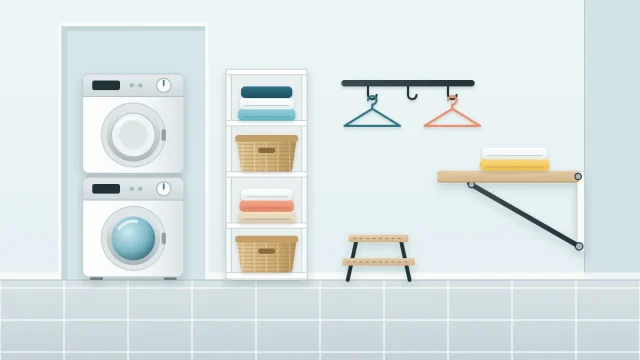
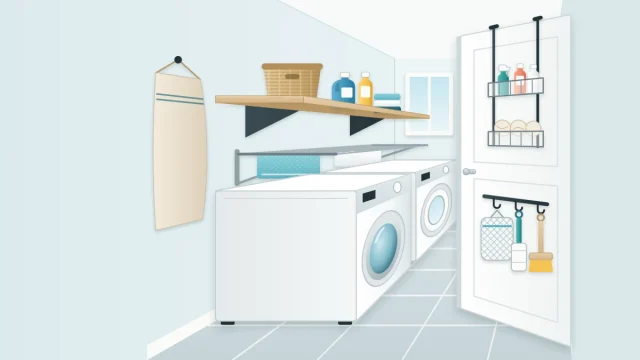
The wall above the machines is the closet’s main storage. One shelf within easy reach holds what you use every wash; a second, higher shelf holds back-stock and light items. More than two usually puts the top one out of reach and crowds the space.
Set the lower shelf so that a top-loader lid opens fully and the controls stay clear, and keep shelves fairly shallow, around 12 in (30 cm), so nothing hides at the back. Put laundry products in their original labeled containers on the highest shelf you can reach comfortably. In a closet that opens onto a hallway or bedroom, that height is the main thing keeping products away from children, so return them there after every use.
Liquids are heavy. Choose shelves with a stated load rating, follow the fixing instructions for your wall type, and check for pipes and cables before drilling, since both are common in the walls of a laundry closet. When unsure, ask a professional. Use a stable step stool for the top shelf and never climb on the machines.
Step 4: Use the side walls
If the manual’s spaces leave the side walls free, they can take narrow storage: a shallow shelf for accessories, a few hooks for mesh bags and a lint roller, or a short rail with hanging cups. Keep it shallow enough that it never touches a machine and never snags laundry as it goes in and out.
Side walls suit light things. For more ways to work upward, see the ideas for laundry room vertical storage.
Step 5: Use the doors, if they can carry it
A hinged door can take an over-door rack or a row of hooks on its back. Check first that the door still closes with the rack loaded and that nothing on it touches the machines or the controls. Use it for light accessories and keep laundry products up on the shelf, because a door rack sits at exactly the height a child can reach.
Bifold and sliding doors usually cannot carry racks. The panels fold or pass over each other, and extra load on them tends to pull them out of their track. With these, treat the doors as doors only.
Step 6: Keep the floor clear and move sorting outside
Nothing should live on the closet floor in front of or beside the machines. Loose items there get kicked under the appliances, block the doors and collect lint. If something has to go low, hang it.
That means the hampers and the folding surface move out. A closet has no room to sort or fold, and trying to do both in the doorway is what makes closet laundry feel chaotic. Instead:
- Keep sorting hampers in the bedrooms or bathroom, where clothes come off.
- Carry one load at a time to the closet in a basket.
- Fold on a bed, a table or a counter nearby, and bring the basket back empty.
The carry basket needs a home too: on the top shelf, on a wall hook, or in the nearest bedroom. The guide to laundry basket storage has options for tight spaces, and the wider principles are in the article on small laundry room organization.
Step 7: Add a light if the closet is dark
Many laundry closets have no fixture of their own, which makes the back of every shelf a guess. A battery-powered or plug-in light, used as supplied, is enough to read a product label and see into the drum.
Step 8: Decide what stays out of the closet
The last step is a list of what does not belong inside. A laundry closet works because it holds very little.
- Anything on or against the vent connection, hoses, valves or power connection. These stay clear and reachable.
- Household overflow: coats, shoes, luggage, paper goods and holiday boxes. They crowd the space the manual asks you to keep free.
- Paint, fuel and other non-laundry chemicals. Store them elsewhere, as their own labels direct.
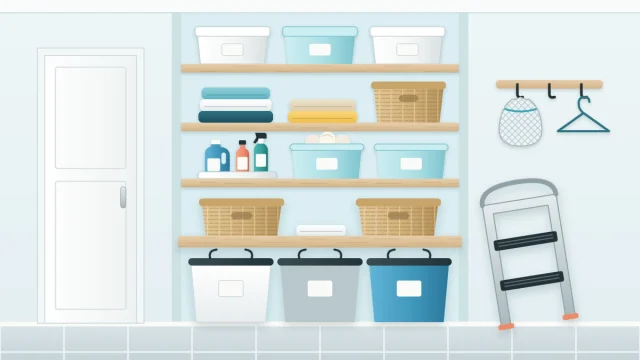
- Bulk back-stock. Keep one spare per product in the closet and the rest in another closed, high cabinet.
- Loose items on top of the machines, unless the appliance manual says the top can be used as a surface.
- Piles of dirty or damp laundry. They belong in a hamper outside until it is their turn.
Frequently asked questions
Do laundry closet doors have to stay open while the machines run?
That depends on your machines and your doors, and the appliance manual is the place to find out. Some manuals ask for doors to be open or of a particular type during use. Follow what yours says, and ask the manufacturer or a qualified professional if the closet does not match it.
Can I hang an organizer on bifold laundry closet doors?
Usually not. Bifold and sliding panels fold or pass over each other, and extra load tends to pull them out of their track. Use the wall above the machines and the side walls instead. Hinged doors can take an over-door rack for light accessories if they still close properly.
Where do hampers go when the laundry is in a closet?
Outside it. Keep sorting hampers in bedrooms or the bathroom, carry one load at a time to the closet in a basket, and fold on a nearby bed or table. The closet floor stays clear so the appliance doors open fully and nothing ends up under the machines.