Storage Ideas Around a Stacked Washer and Dryer
A stacked pair leaves no top surface, so storage moves to the side and the other walls. Ideas for shelving, a fold-down table, hooks and drying space, with the appliance manual setting the limits.
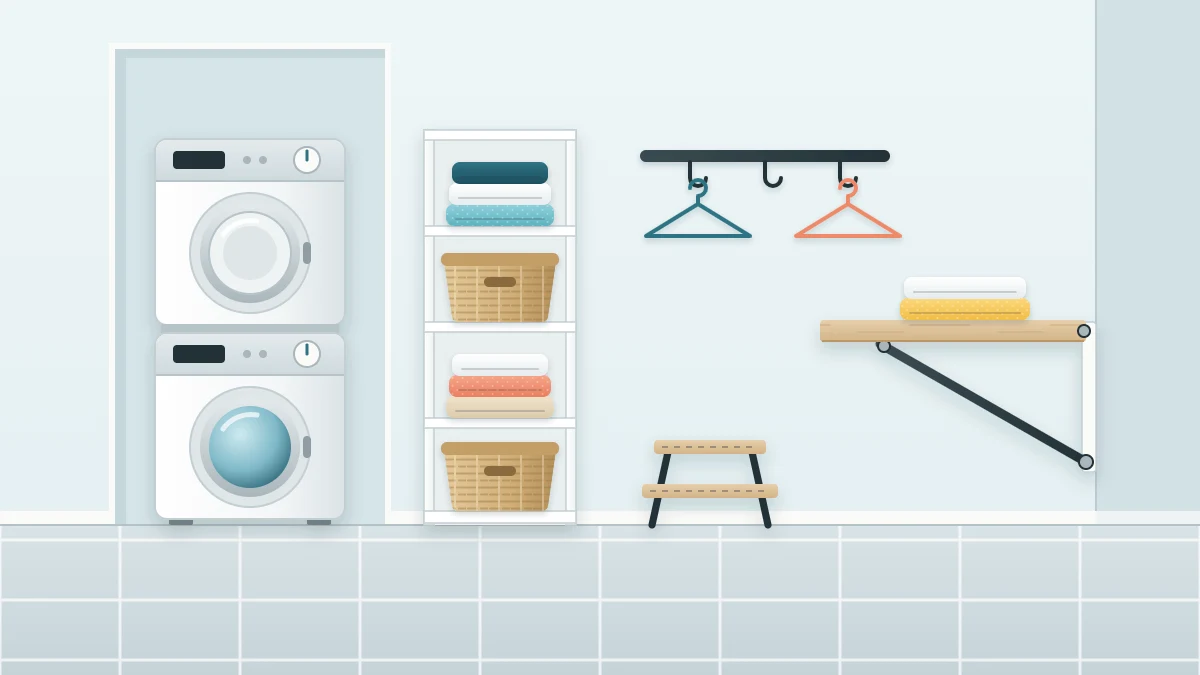
A stacked pair gives back a strip of floor, and takes away the one surface most laundry rooms rely on: the tops of the machines. That trade shapes everything about stacked washer and dryer storage. Nothing can sit on the stack, so shelves, a folding surface and a drying spot all have to move to the side or to another wall.
The ideas below work for a stacked washer and dryer and for a one-piece laundry tower. They are about arranging the room around the appliance, with the appliance manual deciding how close anything may come.
Start with what has to stay clear
Before choosing storage, find the limits. The manual for your machines sets out the space to keep free at the sides, back and top, along with the door swing and the vent path. Read those pages first, then plan storage for whatever is left.
Some rules apply to every layout:
- Nothing goes on top of, behind or pressed against the stack.
- The vent connection, hoses, water shut-off valves and power connection stay reachable and untouched by stored items.
- Nothing hangs from the machines themselves: no hooks over the door, no bags on the handles.
- The floor in front stays open so both doors open fully.
Good to know
This guide covers storage only. Stacking itself is done with the manufacturer’s stacking kit and instructions, and any question about the vent, hoses or power belongs with the manual or a qualified professional.
Use the floor beside the stack
The width a second machine would have filled is now your main storage zone. Two kinds of furniture suit it.
A tall, narrow shelving unit or cabinet
A slim unit standing next to the stack gives several shelves in a small footprint. Keep everyday items between waist and eye height, light spares up top and heavy things low. Liquids are heavy, so check the unit’s stated load rating per shelf. A closed cabinet looks calmer and keeps laundry products out of sight; if children or pets use the room, products go up high or behind a latched door, in their original containers.
Secure any tall freestanding unit against tipping with the restraint supplied or an anti-tip kit, following its instructions. Leave whatever space the manual asks for between the unit and the appliance.
A slim rolling cart
Where there is only a narrow strip, a cart on wheels can hold accessories and pull out when needed. Whether that strip may be used at all depends on the manual. The step-by-step guide to setting up a rolling laundry cart explains how to check and what to load.
Put the walls to work
With no machine tops, the adjacent and opposite walls carry more of the load.
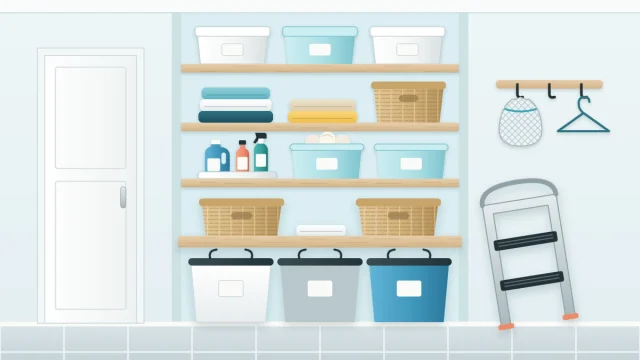
- Wall shelves. Two or three shelves on the wall next to or facing the stack can hold bins of accessories and folded cloths. A depth of about 12 in (30 cm) suits most bins.
- A rail with hooks. A short rail takes mesh bags, a lint roller, hangers and a small dustpan.
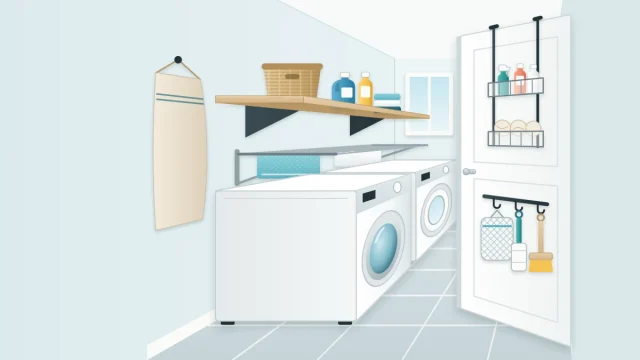
- Over-door racks. The back of the room door is often free. A rack there suits light items; check that the door still closes and that nothing swings into the machines.
- A wall-mounted drying rack. A rack that folds flat gives you a place for items that skip the dryer. Keep the room ventilated when air-drying, and never hang laundry over the appliance vent or on a heater.
For every wall fixing, follow the product’s fixing instructions for your wall type and its load rating, and check for pipes and cables before drilling. Laundry walls often contain both. If you are unsure, ask a professional.
Replace the missing folding surface
Side-by-side machines often double as a counter, subject to their manuals. A stack offers nothing, so plan a folding spot on purpose.
A fold-down wall table is the usual answer in a tight room. It drops flat when not in use and gives a firm surface at about counter height, roughly 36 in (91 cm), when raised. Mount it on a wall where the raised table does not block the doors of the stack or the route out of the room. Wet laundry is heavy, so treat the table’s load rating as a real limit.
If no wall is free, folding may simply happen in another room, and the laundry area only needs a basket slot. The broader guide to small laundry room organization covers that kind of trade-off.
Plan for reach
On a stacked pair, the dryer sits on top, so its door, lint filter and often its controls are higher than usual. On a one-piece laundry tower the controls are commonly placed in the middle, but the dryer drum is still high. Either way, shorter members of the household may need help reaching the back of the drum.
Keep a stable step stool in the room, stored flat against a wall or hung on a hook where it is easy to grab. Never climb on the washer door, a shelf or a counter. The floor in front of the stack has to stay clear for the stool as well as for the doors, which is one more reason baskets belong to the side.
Tip
Stand in front of the stack and open both doors fully. Mark where they reach with a strip of painter’s tape on the floor, and keep everything outside that line.
Spot, idea and what to check first
| Spot | Storage idea | Check first |
|---|---|---|
| Floor beside the stack | Tall narrow shelving unit or cabinet | Space the manual asks for; anti-tip restraint |
| Narrow side strip | Slim rolling cart | Whether the manual allows anything there |
| Adjacent or opposite wall | Shelves, rail with hooks | Wall type, pipes and cables, load rating |
| Opposite wall | Fold-down table | Door swing and walking route |
| Back of the room door | Over-door rack | Door closes; nothing touches the machines |
| Free wall or ceiling area | Wall-mounted drying rack | Room ventilation; clear of the vent |
When the stack lives in a closet
Many stacked pairs sit in a hallway closet with almost no room at the sides. There, the door and the wall outside the closet become the storage. A shallow rack on the inside of a hinged door, a hook for a collapsible basket and one shelf for accessories on a nearby wall may be all that fits, and that is enough.
Do not fill the space around the machines to make up for it. The article on laundry closet organization looks at closets in more detail, including what to store elsewhere in the home.
Frequently asked questions
Can I put shelves above a stacked washer and dryer?
Nothing should sit on the stack itself, and the space the appliance manual asks you to keep free above and around it stays empty. Shelves are better placed on the adjacent or opposite wall, fitted by their own instructions, where they are also easier to reach.
Where do I fold laundry with a stacked washer and dryer?
Plan a separate surface, since the stack offers none. A fold-down wall table on a facing wall is the usual choice in a tight room. The top of a low cabinet works too, or you can fold in another room and keep only a basket slot in the laundry area.
What can I store beside a stacked washer and dryer?
A tall narrow shelving unit, a cabinet or a slim rolling cart can stand beside the stack if the appliance manual allows that space to be used. Secure tall units against tipping, keep heavy things low, and let nothing press on the machines, hoses or vent connection.