Slim Rolling Laundry Cart: Setting One Up Beside the Machines
How to set up a slim rolling cart in a narrow strip of laundry room floor: check the appliance manual first, measure the allowed space, choose useful features, and load it with light everyday items.
At a glance
What you need
- Appliance manuals for the washer and dryer
- Tape measure
- Slim three- or four-tier cart with raised edges
- Small open bins for loose items
- Broom or vacuum for the floor
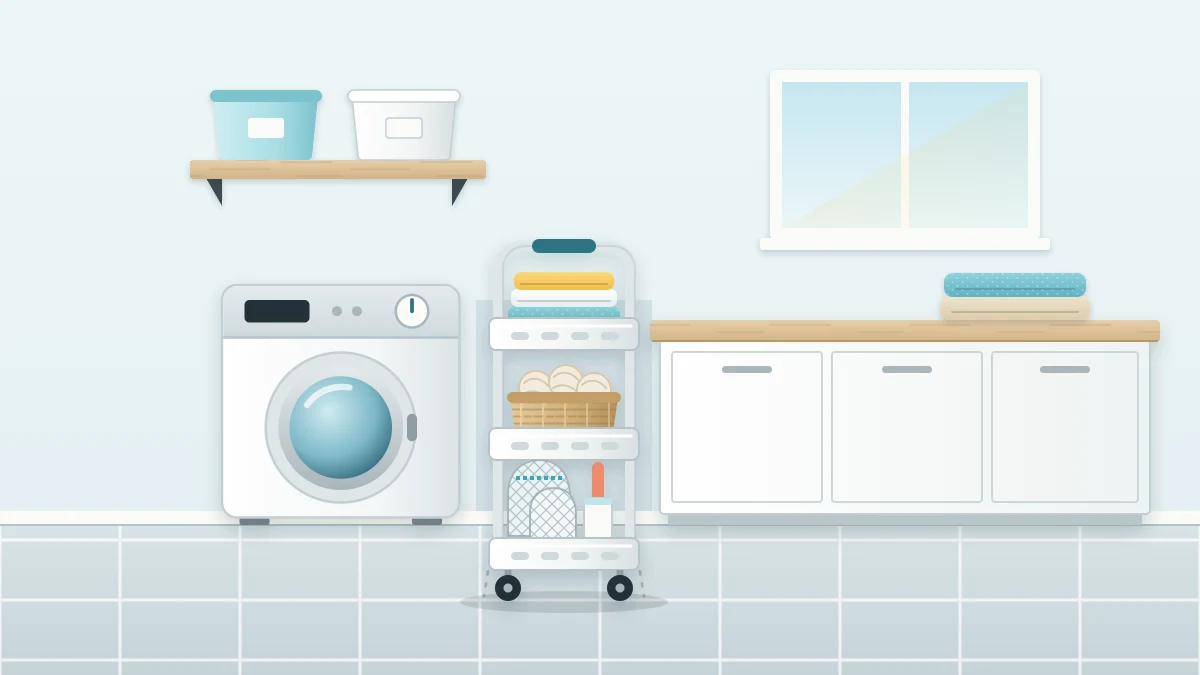
A narrow strip of floor beside the washer, at the end of a counter or next to the utility sink looks like wasted space. A slim rolling laundry cart can turn that strip into several tiers of storage that slide out when you need them and tuck away when you do not.
The cart itself is the easy part. The careful part is deciding whether the spot you have in mind may be used at all, because the space around a washer or dryer is not always free to fill. Work through the steps in order and the answer comes before you spend anything.
Step 1: Find a possible parking place
Walk the room and note every strip of floor that is too narrow for furniture but wide enough for a cart. Common candidates are:
- The space beside a machine or between the washer and dryer
- The end of a counter or cabinet run
- Beside a utility sink
- Between a shelving unit and the wall
Rule out any place where the cart would sit in front of water shut-off valves, a floor drain, an electrical panel or a door. If the room is very tight, the guide to small laundry room organization can help you weigh a cart against other uses of the same floor.
Step 2: Check the appliance manual first
If the place you picked is next to a washer or dryer, open the manual before you measure. Some appliances have to have the space at their sides kept free for air movement, for hoses or because the cabinet moves during a spin cycle. The manual says so, and it is the only source that counts.
If the manual asks for that space, treat it as off limits and park the cart somewhere else. The vent connection in particular is never to be blocked, squeezed or leaned on by a cart or anything stored on it.
Good to know
If you no longer have the manual, look up the model number on the appliance and find the manual from the manufacturer, or ask a qualified technician. Do not rely on a rule of thumb for the space around a machine.
Step 3: Measure the allowed space
Once you know which space is truly available, measure three things: its width at the narrowest point, its depth from front to back and the height under any counter or shelf. Check the width at floor level and again higher up, because baseboards and pipes can narrow it.
Choose a cart that is clearly smaller than those measurements in every direction, so it rolls in and out without scraping and without touching what is on either side.
Step 4: Choose the features that matter
Slim carts look alike, but a few details decide whether one is pleasant to use:
- Three or four tiers. Enough to separate groups of items without making the cart top-heavy.
- Raised edges. A lip or rail on each tier keeps things from sliding off when the cart moves.
- A top handle. You will pull the cart out from the front, so a handle at the top end makes a real difference.
- Wheels suited to your floor. Small hard wheels roll well on tile and vinyl and poorly over grout lines or thresholds.
- A finish that tolerates damp. Plastic or coated metal wipes clean and does not mind a humid room.

Read the cart’s stated load rating before buying, and treat it as a limit for each tier and for the cart as a whole. A tall, narrow cart tips more easily than a low one, so stability matters more than an extra shelf.
Step 5: Load it with the right things
A cart suits light, non-hazardous items that are used often. Good candidates:
- Dryer balls and mesh wash bags
- Clothespins and a lint roller
- Cleaning cloths
- A soft brush and other tools for treating marks
- A small bin for pocket finds
Put the heaviest things on the lowest tier and the lightest on top, so the cart stays steady when it rolls. Give each tier one group, and keep small loose items in an open bin so they do not migrate.
Laundry products need more thought. An open cart at floor level is within easy reach of children and pets. If either uses the room, products stay in the high or latched cabinet, not on the cart. In a household where that is not a concern, a cart can hold the products in current use, always in their original containers with the label facing out and caps closed, on the lowest tier. For the full picture of what goes where, see the guide on how to organize laundry supplies.
Step 6: Pull it out fully, then roll it back
Use the cart the way a drawer is used. Pull it all the way out, take what you need with the cart standing free, and roll it back when you are done. Reaching into a half-open cart is how items get knocked off the back.
When you park it, look at where it ends up. The cart should not rest against the side of a machine, a hose or the vent, and it should never sit against a surface that gets hot or moves during a cycle. If the cart creeps on a sloping floor, choose one with locking wheels or find a different place for it.
Do not use the cart as a step or a seat, and do not let children ride on it.
Step 7: Clean under and behind it
Lint and dust collect in exactly the kind of sheltered strip a cart lives in. Every few weeks, roll the cart right out of its slot and sweep or vacuum the floor there, including the edges you can reach without moving anything else. Wipe the tiers and the wheels while the cart is out.
When a cart is the wrong answer
A cart is not always the best use of a narrow space. If the manual rules out the spot, if the floor is uneven or if the cart would block a door, a wall shelf, a rail with hooks or a bin on an existing shelf may serve better. Filling every strip of floor just because it is there is one of the common laundry room organization mistakes, and an empty strip that keeps the machines accessible is doing a job of its own.
Frequently asked questions
Can I put a rolling cart between my washer and dryer?
Only if the appliance manuals allow it. Some machines have to keep the space at their sides free for air movement, hoses or movement during a spin cycle. Read the manual for each machine first, and if it asks for that space, park the cart somewhere else in the room.
What should I keep on a laundry cart?
Light, non-hazardous things you use often: dryer balls, mesh bags, clothespins, a lint roller, cloths and a soft brush. Put the heaviest items on the lowest tier. Laundry products go on a cart only if children and pets cannot reach it, and always in their original containers.
How do I stop a slim laundry cart from tipping?
Choose a cart with a stable base, keep within its stated load rating and load the heaviest items on the lowest tier. Pull it out fully before taking things off, roll it on a level floor, and do not let anyone lean, sit or stand on it.