Laundry Room Wall Storage: Rails, Hooks and Pegboards
What suits a laundry room wall, which rails, hooks, pegboards and holders do which job, and how to plan the layout around the machines and what is inside the wall.
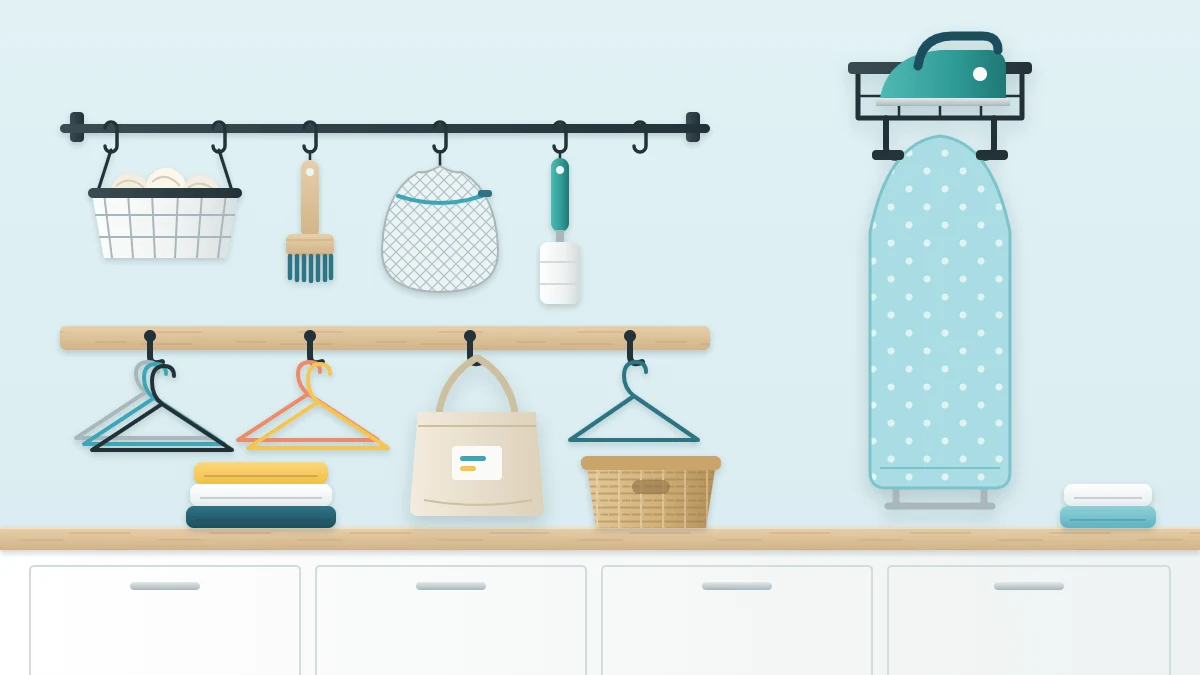
When the floor is full, the walls are usually still empty. Good laundry room wall storage moves the light, awkward and constantly used things off the counter and the machine tops, and gives each of them a visible place to return to.
Walls are not the answer for everything, though. This guide covers what suits a wall, which hanging systems do which job, and how to plan the layout so nothing gets in the way of the washer, the dryer or whatever is hidden inside the wall itself.
What suits a wall, and what does not
Four kinds of items are happier hanging than sitting on a shelf:
- Light things: mesh bags, a lint roller, a clothes brush, a cloth bag of clothespins.
- Flat things: the ironing board, a folded drying rack, a pressing cloth.
- Long things: brooms, mops, a duster, a garment on a hanger.
- Things used with every load: whatever you reach for so often that opening a cabinet feels like a chore.
Laundry products are the exception. Detergent, bleach, softener and stain remover do not belong on open hooks or in low wall pockets. The bottles are heavy, and anything hung low and in plain view is within a child’s reach. Keep them in their original labeled containers, up high or in a closed, latched cabinet, and store them as the label says.
Wall systems and what each one does best
A rail with S-hooks
A single metal rail is the most flexible option. S-hooks slide along it, and hanging cups or small baskets clip on for loose items. Because everything can be moved sideways, the arrangement can change as your routine does, with no new holes.
Individual hooks
A short row of sturdy hooks handles spare hangers, a cloth bag, an apron or the basket you carry upstairs. They are easy to add one at a time.
A pegboard panel
A pegboard turns one section of wall into a grid you can rearrange at will. It suits a collection of small tools that would otherwise live in a drawer. Layout, accessories and fixing are covered in the guide to setting up a laundry room pegboard.
Single-purpose holders
- Ironing board holder: holds the board flat against the wall, often with a shelf or cradle for the iron.
- Broom and mop clip rail: grips handles so long tools hang clear of the floor.
- Wall-mounted drying rack: folds flat when empty; the different styles are compared in these drying rack ideas.
- Magnetic or clip strip: keeps scissors, tweezers and a seam ripper in sight.
- Wall pockets: fabric or rigid pockets for mesh bags, cloths and, if the pocket hangs high and out of children’s reach, a box of dryer sheets.
What goes where
Start with the largest item, because it dictates the rest. The ironing board needs a tall, uninterrupted strip of wall, ideally near where you iron. If its holder has a place for the iron, let the iron cool fully before you store it and follow the storage advice in its manual.
Next, place the things used at the machines: the lint roller, a brush and the mesh bags go within arm’s reach of the washer, roughly between hip and eye level. Spare hangers belong beside the hanging rod, so a shirt can go from the dryer to a hanger in one movement. If you have no rod, a short wall-mounted one, or a rail with a few hooks, does the same job in a small space.
Brooms and mops go nearest the door, where they can be grabbed without walking through the room. Small tools go on the strip or pegboard above the folding surface. Empty baskets can hang too, on large hooks or brackets, and there are more options in the guide to storing laundry baskets.
Plan the wall before you buy
A laundry wall is rarely a blank surface. Work through these checks with a pencil and a tape measure:
- Map what is inside the wall. Find the studs, and check for pipes and cables before you drill. Laundry walls often contain both, and they do not always run where you expect. If you are unsure, ask a professional.
- Leave the connections alone. The wall behind and around the machines carries the water valves, hoses, the power connection and the dryer vent connection. Keep that area clear, along with whatever space the appliance manual asks for.
- Check every swing. Open the washer door, the dryer door, the room door and any cabinet doors fully. Nothing on the wall should be in their path, and nothing hanging should be able to swing into an appliance door or its controls.
- Think about reach. Daily items go between hip and eye level. Rarely used items can go higher, with a stable step stool kept nearby. Never climb or stand on a machine or a counter to reach them.
Fixing things to the wall
How a rail or holder is fixed matters more than which one you choose. Each product comes with fixing instructions for particular wall types, such as drywall over studs, masonry or tile, and with a stated load rating. Follow both. Use the fixings recommended for your wall, not simply the ones that happen to be in the box.
Remember that the load is more than the object itself. A drying rack carries wet laundry, which is far heavier than dry, and a hook gets tugged every time you pull something off it.
Adhesive hooks are useful for renters and for tiled walls, but only within their stated limits and on the surfaces their instructions list. Textured paint, damp walls and dusty surfaces are common reasons they let go. Reserve them for light items such as a lint roller or a mesh bag.
Good to know
If you rent, or if you cannot be sure what runs behind the wall, a freestanding unit or an over-door rack may be the better choice. When a fixing job is beyond what you are comfortable with, ask a qualified professional.
Keeping the wall useful
Wall storage only works while it stays sparse. A wall crowded edge to edge is as hard to use as a cluttered shelf, and things start to hide behind each other.
Give each hook a single job. If something has hung untouched through a whole season, take it down and free the space. Leave a hook or two empty on purpose, so that a damp cloth or a delicate garment always has somewhere to go.
Frequently asked questions
What should I hang on a laundry room wall?
Hang things that are light, flat, long or used with every load: the ironing board, a folded drying rack, brooms and mops, spare hangers, mesh bags, a lint roller and small tools. Laundry products are better kept in their original labeled containers, up high or in a closed, latched cabinet.
Are adhesive hooks strong enough for a laundry room?
They can be, for light items, when used within the limits and on the surfaces listed in their instructions. Damp, dusty or textured walls are common reasons they fail. Keep them for things like a lint roller or a mesh bag, and use fixed hardware with a stated load rating for anything heavier.
Can I put hooks on the wall behind the washer and dryer?
It is better to leave that wall alone. It usually carries the water valves, hoses, the power connection and the dryer vent connection, and may hide pipes and cables. Keep the area clear, follow the appliance manual for the space around the machines, and use a side wall instead.