Storage Above a Washer and Dryer: Options That Stay Reachable
Five ways to use the wall above side-by-side machines, from a single shelf to a bridging counter, with the reach, lid and access checks that decide which one fits your room.
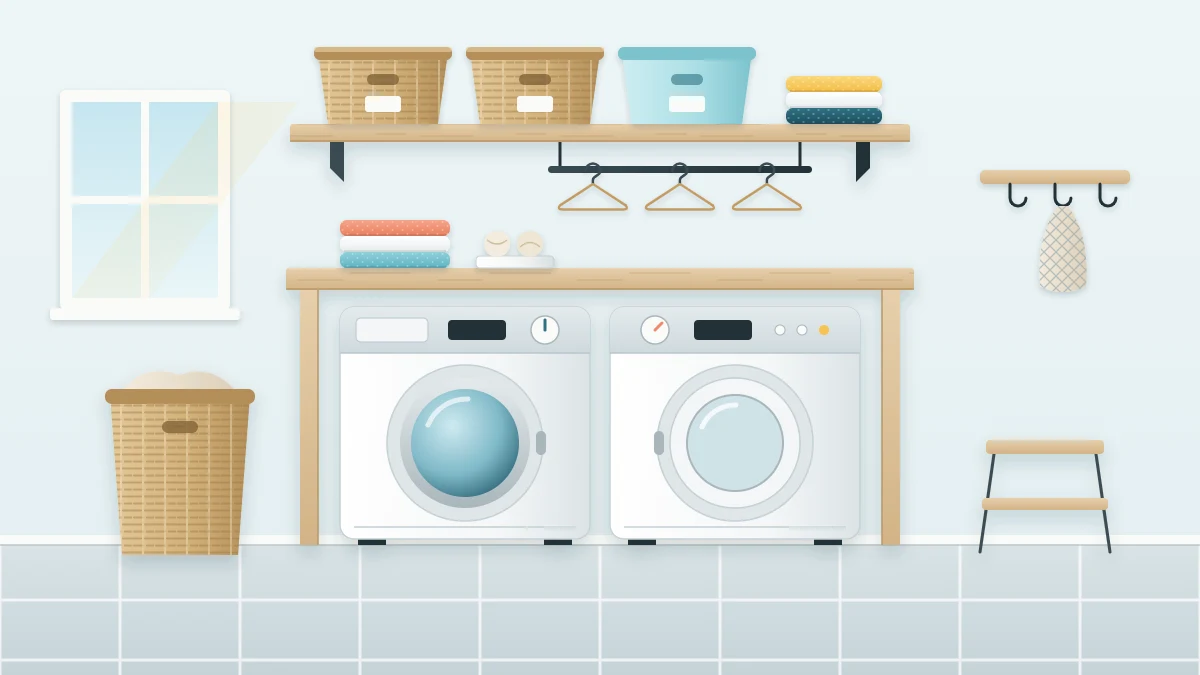
The wall above a side-by-side pair is usually the largest unused surface in a laundry room. It is also an awkward one: you have to reach over the machines to get to it, and the wall behind them carries the vent, water and power connections.
Any plan for storage above washer and dryer pairs therefore answers two questions at once. What will you put there, and can you reach it with both feet on the floor? The options below run from the simplest to the most built-in.
Settle the reach question first
Stand in front of the machines and reach forward and up, without leaning on them. The highest point where you can comfortably grip a bottle is the top of your everyday zone. Anything stored above that needs a stable step stool, so it should be something you fetch rarely.
The lowest shelf has a limit as well. With a top-loader, the lid has to open fully, so open it and mark the wall just above the highest point it reaches. With either type, the controls must stay easy to see and use, and nothing on the shelf should hang down in front of them.
Between those two marks is your working band. Three habits make the most of it:
- Heavy things, such as full bottles of liquid, go on the lowest shelf.
- Light, bulky things, such as spare paper towels or an empty basket, go higher.
- Shallow beats deep. A shelf about 10 to 12 in (25 to 30 cm) deep keeps everything in one row you can see.
Good to know
Use a stable step stool for anything above easy reach. Never climb or stand on a washer or dryer, and never lean your weight on an open door.
One or two wall shelves
A plain wall shelf is the quickest way to use the space, and often the only thing a narrow room has width for. One shelf holds the products you use every wash, in their original labeled containers, plus a small bin of accessories. A second shelf above it takes back-stock and light items.
Shelves leave everything in view, so group items in open bins. The guide to laundry room shelving ideas compares bracket, floating and track shelves in more detail.
If children use or pass through the room, an open shelf within their reach, or within reach from the top of a machine they could climb, is not the place for laundry products. Those belong higher up or behind a latched door.
A wall cabinet
A cabinet does the same job behind doors. It hides visual clutter, keeps lint and dust off the contents, and can take a latch, which helps keep products out of sight and out of reach of children. A latch is a help and not a substitute for putting products away right after use.
The trade-offs are depth and door swing. A deep cabinet above the machines pushes the back of each shelf beyond easy reach, so keep the contents toward the front and use a turntable or a pull-forward bin for the rest. There is more on choosing and arranging them in the article on laundry room cabinets.
A shelf with a hanging rod
A rod fixed under a shelf, or a shelf sold with one, adds hanging space for shirts that come out of the dryer and for a few items left to air-dry. It suits front-loaders best, because hanging clothes need room to drop and would get in the way of a top-loader lid.
Keep the rod short and the hangers few. Wet laundry is heavy, so hang a full load on a drying rack elsewhere. Hanging garments should never rest against the controls or trail behind the machines.
A rail with hooks and small baskets
A wall rail with movable hooks, cups and small baskets is the lightest option. It is the right home for accessories: a lint roller, mesh bags, a small brush, clothespins in a hanging cup, a pair of scissors.
It is the wrong home for full-size bottles, because small hanging baskets are not made for heavy liquids.
A counter or bridging shelf over front-loaders
With two front-loaders side by side, a counter across the top gives you a folding surface and stops socks falling into the space behind. The most straightforward kind does not rest on the machines at all: it is carried by the side walls, by a rail on the back wall, or by its own legs or side panels.
That detail matters, because the top of a machine is not automatically a work surface. Before you store or fold anything directly on a washer or dryer, read the appliance manual. Some manufacturers advise against it, and vibration during a spin cycle can walk loose items toward the edge. A counter with its own support avoids the question.
Whichever kind you choose, it must not block any drawer, filter cover or control on either machine.
A stacked pair leaves no top surface at all and needs a different approach, covered in storage ideas for a stacked washer and dryer.
Keep the wall behind the machines accessible
The lower part of the wall is working space for the appliances. The dryer vent connection, the water shut-off valves, the hoses and the power connection all need to stay visible and reachable, and nothing you add should press on them or box them in.
How much space, door swing and vent path each machine needs is set by its appliance manual, not by a general rule, so follow the manual for your models. If a planned shelf or cabinet would cover a valve or a connection, move the storage up or sideways. Leave the connection where it is; anything involving the vent, hoses or power is a job for the manual and a qualified professional.
Fixing shelves and cabinets safely
Liquids are heavy, and a shelf above the machines tends to collect more of them over time. Three points apply to every option here:
- Use the product’s stated load rating. Plan for the shelf fully loaded with bottles, not as it looks on day one.
- Follow the maker’s fixing instructions for your wall type. That means fixing into wall studs or using anchors suited to the wall, as the instructions describe.
- Check for pipes and cables before drilling. The wall behind a washer and dryer often contains both. If you are unsure, ask a professional.
Frequently asked questions
How high should a shelf above a washer and dryer be?
There is no single figure. Place the lowest shelf where you can reach it with both feet on the floor, but high enough that a top-loader lid opens fully and the controls stay clear. Mark both limits on the wall in your own room, and follow the appliance manual for any space it asks for.
Can I store things directly on top of my washer or dryer?
Check the appliance manual first. Some manufacturers advise against using the machine top as a storage or work surface, and vibration can move loose items toward the edge. A counter or shelf carried by the walls or its own legs gives you a surface without resting anything on the machines.
Are open shelves or a cabinet better above the machines?
Open shelves are quick to reach and suit narrow rooms, but everything stays in view. A cabinet hides clutter and can be latched, which helps keep laundry products away from children. Many rooms use both: a cabinet for products and a shelf or rail for baskets and accessories.