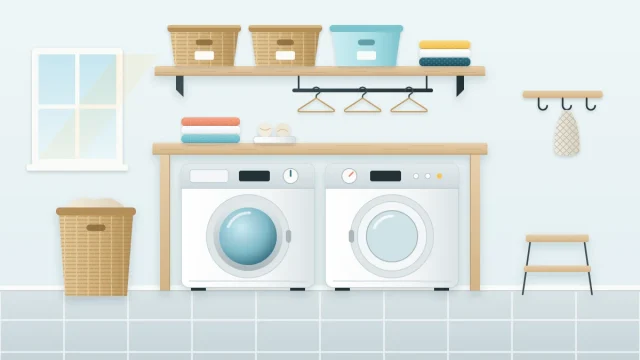
Laundry Room Cabinets: What to Store Where
How to assign the space inside wall, base, sink and tall cabinets in a laundry room, which organizers help, and why a short list of what lives on each shelf keeps closed storage working.

Cabinets hide a great deal, which is both their strength and their weakness. Behind a closed door a shelf can be perfectly arranged or a heap, and the room looks the same either way until you need the stain remover in a hurry.
If you already have laundry room cabinets, or are about to get some, the useful question is not how many you have but what goes on which shelf. A clear assignment for each one makes the inside as calm as the outside.
Upper cabinets: the home for laundry products
Wall cabinets do the most important job in the room. They are high, they close, and they can be latched, which makes them the right place for detergent, bleach, softener and stain remover. Every product goes in there in its original container, cap closed and label facing the door.
In a home where children live or visit, fit a latch and use it. A latch is a help and not a replacement for putting products back right after use and keeping an eye on small children. For more household detail, see the American Academy of Pediatrics page on laundry room and detergent safety.
Inside an upper cabinet, assign by frequency of use:
- Lowest shelf: the products you use for almost every load. This is the easiest shelf to reach, so it earns the everyday items.
- Middle shelf: occasional products and accessories such as mesh bags and a lint roller.
- Top shelf: light back-stock and things used a few times a year.
Keep the heaviest containers on the lowest shelf, where you lift them at chest height instead of over your head. The reasoning behind height, latches and grouping is set out in the guide to laundry detergent storage.
Base cabinets: bulky, light things
Base cabinets are at exactly the height a toddler explores, so they are the wrong place for laundry products unless the doors lock. What they suit is everything bulky, light and harmless:
- Spare baskets and a folded hamper liner
- Cleaning cloths and old towels for spills
- A bucket
- The clothespin bag and spare hangers
- Folded drying-rack accessories or an ironing blanket
Deep base cabinets swallow things. A pull-out tray or a pair of open bins used as drawers brings the back of the cabinet forward, so you are not kneeling on the floor with a flashlight.
The sink base cabinet
The cabinet under a utility sink is shaped by its pipes. Leave them, and the water shut-off valves, visible and reachable: this is a space someone may need to get into quickly.
Keep what lives there in a single lift-out caddy, such as scrubbing brushes, rubber gloves and a few cloths. One handle clears the whole cabinet in a second. Avoid packing the floor of the cabinet edge to edge, and do not hang anything from the pipes.
The cabinet over the appliances
A cabinet above the washer and dryer is well placed and often awkward, because you reach it across the depth of a machine. Before you assign anything to it, check that you can open the doors fully and see the shelves.
If you cannot reach it flat-footed, use a stable step stool placed in front of the machine. Never climb or kneel on a washer or dryer to get to a shelf. If even the stool leaves the top shelf out of comfortable reach, reserve that shelf for light, rarely used items, or leave it empty.
Good to know
If you are adding a cabinet, follow the cabinet maker’s fixing instructions and stated load rating for your wall type, and check the appliance manual for any space that has to stay clear above the machines. Laundry walls often contain pipes and cables, so check before drilling and ask a professional when unsure.
A tall cabinet for the long, awkward things
If the room has a tall cabinet, or space for one, give it to the items that never fit anywhere else: the ironing board, a broom and dustpan, a folding drying rack and a long-handled duster. Hooks or clips on the inside walls keep handles upright so they do not slide out when the door opens.
A shelf near the top can take the iron once it is fully cool. Freestanding tall cabinets should be secured against tipping with the restraint supplied or an anti-tip kit, following its instructions.
Organizers that work inside a cabinet
A few simple inserts make the difference between shelves you can use and shelves you rummage through.
- Shelf risers lift a back row so you can see two rows of original containers at once.
- Turntables suit bottles in a corner or a deep cabinet. A spin brings the one at the back to the front. Choose one with a raised rim.
- Open bins act as drawers. Group by type, slide the bin out, take what you need and slide it back.
- Door-mounted racks hold light, flat items only, such as a lint roller, a packet of mesh bags or a small notepad. Check that the door still closes without striking the shelves.
- Pull-out trays are most useful in base cabinets, where depth works against you.
Measure the inside of the cabinet, including the space lost to hinges and the face frame, before choosing any of these. For how to group the accessories and extras that share these shelves, see the guide on how to organize laundry supplies.
Keep a short list of what lives where
The drawback of closed storage is that nobody can see the plan. A short list fixes that. Write one line per shelf and tape it inside a door:
- Left upper, bottom shelf: everyday detergent, stain care
- Left upper, top shelf: back-stock
- Right upper: cloths, mesh bags, lint roller
- Base: baskets, bucket, old towels
The list helps other people in the house put things back, and it shows you at a glance when a shelf has drifted from its job.
When cabinets are not the whole answer
Cabinets are best for products and for anything you would rather not look at. They are less suited to things you reach for with full hands, such as baskets in constant use, or to damp items that need air. Many rooms work best with one or two closed cabinets for products and an open shelf or rail for the rest.
If you are still deciding between the two, the comparison of open shelves and cabinets in a laundry room weighs dust, visibility, cost and safety side by side.
Frequently asked questions
What should go in the upper cabinets of a laundry room?
Laundry products, in their original containers with caps closed. Upper cabinets are high and can be closed and latched, which keeps products out of reach and out of sight of children and pets. Put everyday items on the lowest shelf and light back-stock or rarely used things higher up.
Can I keep detergent in a base cabinet?
Only if the doors lock or latch, because base cabinets are at a height young children can open easily. A wall cabinet is the better place. Use base cabinets for bulky, light and harmless things instead, such as spare baskets, cloths, old towels and a bucket.
How do I organize a deep laundry cabinet?
Bring the back forward. Use open bins that slide out like drawers, a turntable for bottles, a shelf riser so the second row is visible, or a pull-out tray in a base cabinet. Measure the inside first, allowing for hinges, and tape a short list of contents inside the door.