Laundry Room Storage Ideas for Every Layout
Storage options arranged by where they go: walls, above and beside the appliances, the door, under a counter and the floor, with a sensible combination for a dedicated room, a closet and a utility corner.
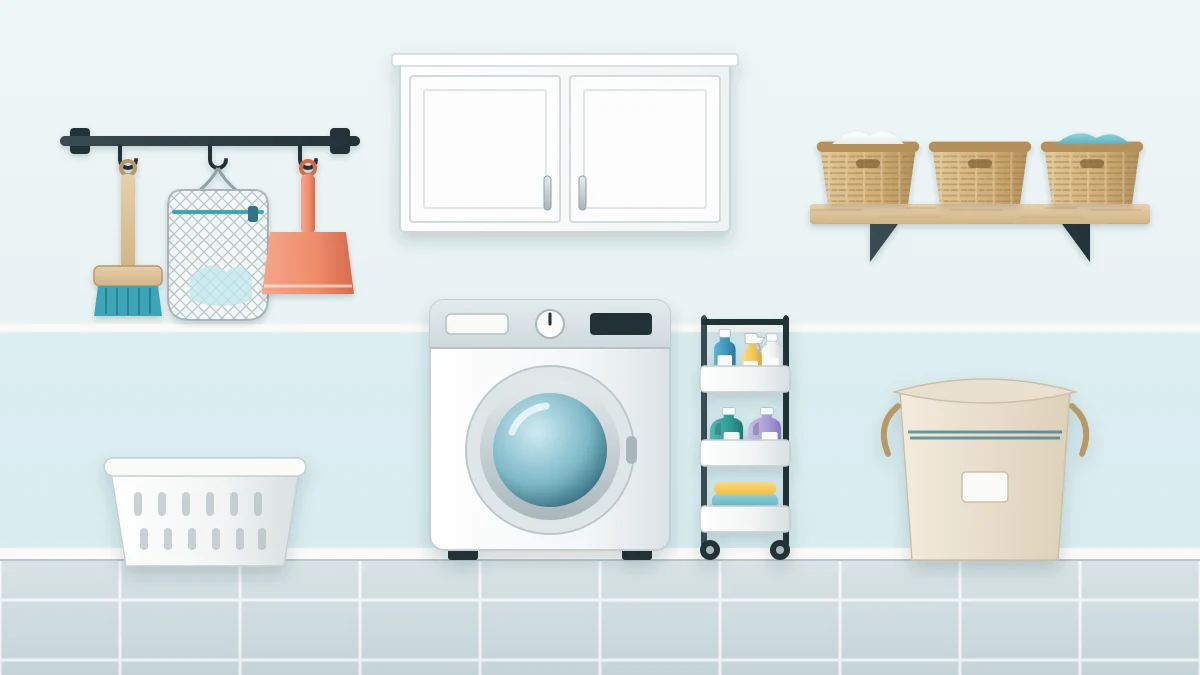
Most lists of laundry room storage ideas are organized by product: here is a cart, here is a basket, here is a shelf. That is not much help when your real question is what to do with the wall above the dryer or the narrow strip beside the washer.
This overview is arranged by place instead. For each part of the room it covers what kind of storage fits there, what it is good for and what to check before you choose it. Three typical layouts at the end show how the pieces go together.
Three checks before you choose anything
These apply to every idea below, so they are stated once.
- Measure first. Note the width, height and depth of each free space, plus the swing of the room door and both appliance doors.
- Keep the working parts reachable. Appliance doors, controls, the lint filter, water shut-off valves, hoses and the dryer vent connection must stay clear and easy to get to. Where the appliance manual asks for space to be left around a machine, storage stays out of it.
- Check the load rating. Liquids and wet laundry are heavy. Any shelf, hook, rail or rack should be chosen by its stated load rating and fixed as its instructions describe for your wall type.
On the walls
Walls are the largest unused surface in most laundry rooms. Four kinds of storage suit them.
- Shelves hold bins, baskets and supplies in their original containers. They are the most flexible choice and the easiest to overfill.
- Rails take hangers for air-drying shirts, or hooks for tools.
- Hooks suit single items with a loop or handle: a mesh bag, a lint brush, the ironing board on its own bracket.
- Pegboard turns a patch of wall into adjustable storage for light accessories, and it can be rearranged as needs change.
Before drilling, check for pipes and cables, since laundry walls often contain both, and ask a professional when unsure. The different shelf types are compared in the guide to laundry room shelving ideas, and hooks, rails and pegboard are covered under laundry room wall storage.
Above the appliances
The wall over the washer and dryer is the natural home for laundry products, because it is close to where they are used and high enough to be out of a child’s reach. You have three main choices.
An open shelf is the simplest and keeps everything visible. A wall cabinet hides the visual clutter and, with a latch, puts products behind a closed door, which matters in any home where children live or visit. A counter over a pair of front-loaders adds a folding surface and gives baskets somewhere to wait.
What to check: that you can reach the shelf or cabinet comfortably from a stable step stool, never by climbing on a machine; that nothing presses on the vent connection or hoses behind; and that the appliance manual allows a counter or anything else above or on top of the machine. If cabinets are the direction you are leaning, see how to assign the space inside laundry room cabinets.
Between and beside the appliances
A narrow strip between the washer and a wall, or between the two machines, can look like wasted space. Sometimes it is usable and sometimes it has to stay empty: the appliance manual decides, so read it before you fill the space.
Where storage is allowed there, two pieces fit. A slim cart on wheels holds supplies or accessories and pulls out when you need it, which also keeps the floor behind it cleanable. Narrow freestanding shelving makes use of a taller strip beside the last machine. Tall units of any kind should be secured against tipping with the restraint supplied or an anti-tip kit, following its instructions.
Sizes, wheels and what to load onto each tier are covered in the guide to choosing a rolling laundry cart.
On the back of the door
A door offers a full-height surface that costs no floor space. Over-door racks hold light, flat things such as a folding drying rack, the ironing board or a row of pockets for accessories. Over-door hooks take hangers on laundry day, or a hanging bag for delicates waiting their turn.
What to check: that the door still closes fully with the rack in place, that the rack does not swing into a machine when the door opens, and that what hangs there is light. Laundry products do not belong on a door rack at a height a child can reach.
Under a counter or sink
The space below a counter suits pull-out bins or a row of baskets, one per person or per load type. Because they slide out, nothing gets lost at the back.
Under a utility sink, a lift-out caddy keeps cloths, brushes and gloves together and comes out in one move when someone needs to reach the pipes or shut-off valves. Keep this space lightly filled for that reason. If products are kept in a base cabinet at all, the doors should lock or latch.
On the floor
Floor space is the scarcest kind, so give it only to things that cannot go anywhere else. Hampers come first, since dirty laundry needs a landing place. A freestanding shelving unit can replace wall shelves in a rental or where drilling is not an option, as long as it is secured against tipping.
Three layouts and what suits each
A dedicated laundry room
With four walls to work with, use a cabinet or shelf above the machines for products, a counter for folding, a rail for hanging and a row of hampers by the door. A tall cabinet or wall hooks can take the ironing board and drying rack.
A hallway laundry closet
Here everything goes up or onto the doors. One or two shelves above the machines, an over-door rack for light items and a slim cart, if the manual and the space allow one, are usually the limit. Hampers live in bedrooms and travel to the closet.
A corner of a utility room or garage
The laundry area needs a clear boundary so household overflow does not drift into it. A freestanding unit beside the machines, closed lidded bins to keep dust out and a wall-mounted drying rack define the corner. Keep storage away from the water heater, furnace and electrical panel, which need to stay accessible.
Frequently asked questions
What is the best storage for a laundry room?
There is no single best piece. The right choice depends on where your free space is. Wall shelves or a cabinet above the machines suit most rooms, a door rack helps in a closet, and a freestanding unit works where you cannot drill. Measure first and choose to fit.
Can I put storage between the washer and dryer?
Only if the appliance manual allows it. Some machines need the space around them left open, and hoses, valves and the vent connection must stay reachable. Where it is permitted, a slim cart on wheels is the most practical option because it pulls out easily for cleaning and access.
How do I add laundry storage without drilling into walls?
Look at freestanding shelving secured against tipping, over-door racks and hooks, a rolling cart and pull-out bins under an existing counter. These add a lot of capacity in a rental. Check each product's stated load rating and keep heavy liquids on low, stable shelves that children cannot reach.