
Solar Powered Desk Chargers That Really Shine
The Smartest Way to Keep Your Devices Charged in 2026
A solar powered desk charger is one of the most practical upgrades you can make to your workspace right now. Whether you want to cut your electricity bill, reduce your carbon footprint, or simply never scramble for a cable again, these devices deliver real, everyday value.
Quick answer — best solar powered desk chargers in 2026:
| Product | Capacity / Output | Best For |
|---|---|---|
| boogostore Solar Power Bank | 50,000mAh, 65W USB-C | Laptops + phones |
| MARBERO Portable Power Station | 88Wh lithium, AC outlet | Desk + emergency backup |
| GOODaaa Power Bank | 36,000mAh, wireless Qi | Multi-device desk use |
| MARBERO 30W Foldable Panel | 30W solar input | Paired with power stations |
| DENVIX PowerX | Compact solar power bank | Light everyday charging |
The idea of harnessing sunlight to power your desk devices isn’t new — but in April 2026, the technology has finally caught up with the promise. Panels are more efficient. Batteries are bigger. And the products are actually designed for real desk setups, not just camping trips.
Here’s the honest reality though: solar charging at your desk has real limits. Indoor light is much weaker than direct sunlight. Most solar panels on portable chargers are small. And charging speeds can be much slower than plugging into the wall.
That doesn’t mean they aren’t worth it. It just means you need to pick the right product for the right use case.
This guide breaks down exactly what to look for, what to avoid, and which models are worth your money in 2026.
Understanding the Solar Powered Desk Charger
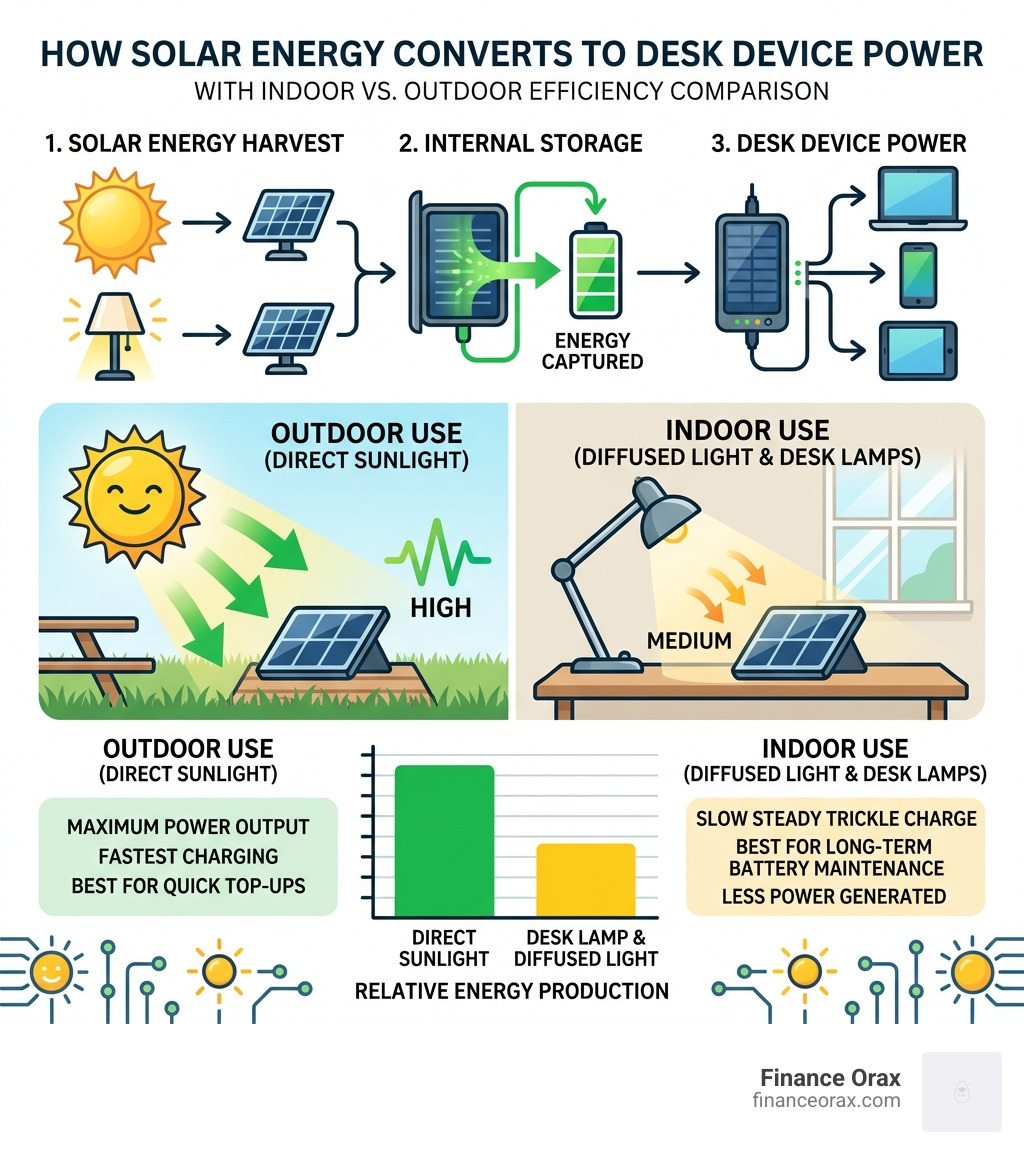
When we talk about a solar powered desk charger, we are looking at a specialized category of tech that bridges the gap between rugged outdoor gear and sleek home office accessories. Unlike traditional portable solar panels—which are often bulky, floppy, and designed to be strapped to a backpack—desk-specific models focus on aesthetic integration and “set-it-and-forget-it” functionality.
The primary difference lies in how they handle light. Traditional panels are “sun-hungry,” requiring direct, harsh ultraviolet rays to produce any meaningful current. Modern desk chargers, however, are increasingly utilizing advanced technologies like dye-synthesised solar cells. These cells mimic photosynthesis, using properties similar to plant chlorophyll to capture energy from diffused indoor light. This means your desk lamp or the light through your window can actually contribute to your battery levels.
Innovative designs have even led to products like the Smart Solar Table With Wireless Phone Charger – NEWLIGHT ENERGY, which integrates the solar panel directly into the furniture surface. These setups often feature photoelectric control, allowing the unit to sense light levels and manage power distribution automatically.
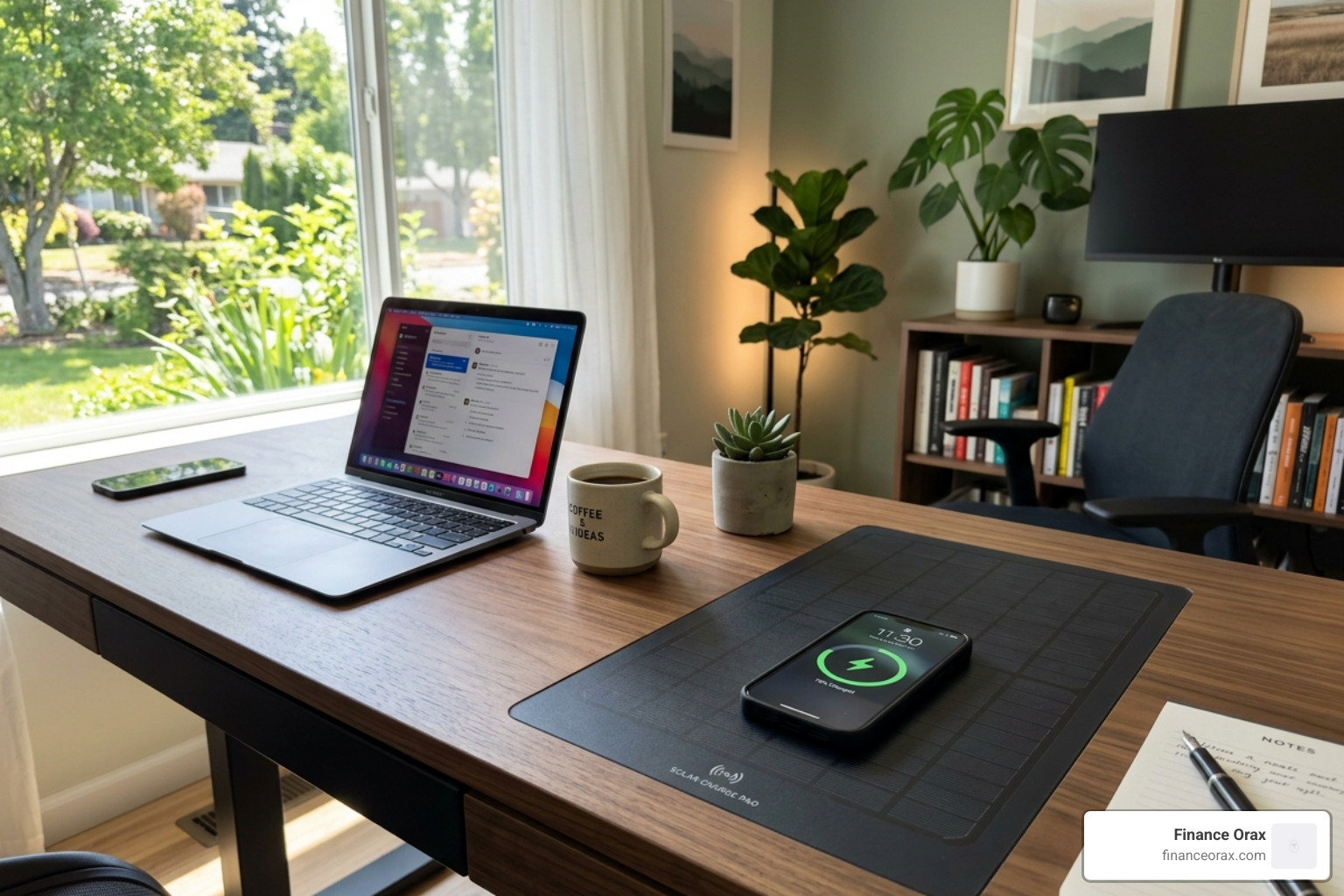
By combining integrated battery storage with a high-design aesthetic, these chargers move away from the “survivalist” look and into the realm of sustainable decor. They use the world’s most dependable resource—the sun—to power your productivity without adding to the cable clutter under your feet.
Key Features of a Solar Powered Desk Charger
Choosing the right solar powered desk charger in 2026 requires looking past the marketing fluff and focusing on the hardware that actually moves the needle. Here is what we recommend prioritizing:
- Power Output and USB-C PD: For 2026, a 65W USB-C Power Delivery (PD) port is the gold standard. This allows you to charge not just phones, but also modern laptops like MacBooks or Dell XPS models.
- Panel Surface Area: Physics hasn’t changed; a larger panel captures more photons. Look for chargers that offer foldable expansions or large integrated surfaces.
- Wireless Qi Pads: Desk chargers should simplify your life. Having a Qi-enabled top surface means you can just set your phone down and let it trickle charge throughout the day.
- Multi-Port Hubs: Your desk likely has a phone, a tablet, and perhaps wireless earbuds. Look for units that can handle at least three devices simultaneously.
- Aesthetic Integration: Designers like Marjan van Aubel have pioneered the idea of “The Current Table,” where the glass surface itself is the panel. The Current Table by Marjan van Aubel features a solar panel for charging mobile phones and demonstrates how solar tech can be a beautiful part of your room rather than an eyesore.
Maximizing Efficiency for Your Solar Powered Desk Charger
To get the most out of your setup, you can’t just place it anywhere and hope for the best. Efficiency is all about placement.
- The Window Factor: While some cells work in diffused light, direct sunlight is roughly 10 to 20 times more powerful. Placing your charger on a south-facing windowsill (in the northern hemisphere) is the single best way to boost speeds.
- Angle Adjustment: Solar panels work best when the sun hits them at a 90-degree angle. Some desk lamps, like the Solar Desk Lamp and Charger – California Sunlight, feature foldable designs that allow you to tilt the panel toward the light source.
- Use Accessories: If your desk is in a dark corner, consider a 30W foldable panel accessory. You can place the panel in the sun and run a single cable back to your desk-bound power bank.
- Maintenance: Dust is the enemy of solar efficiency. A thin layer of office dust can reduce power intake by 10% or more. Give your panels a quick wipe with a microfiber cloth once a week.
Performance and Realistic Charging Speeds
Let’s get real about the numbers. Many manufacturers claim “infinite power,” but in a desk environment, you are dealing with specific capacities and recharge cycles.
A solar powered desk charger with a 25,000mAh capacity is generally enough to charge a smartphone 4-5 times or a tablet once. However, if you are looking to keep a laptop running, you should aim for 50,000mAh models with high wattage (65W+) output.
| Capacity | Watt-Hours (Wh) | Laptop Charges | Smartphone Charges | Solar Recharge Time (Strong Sun) |
|---|---|---|---|---|
| 25,000 mAh | ~92 Wh | 0.8 – 1.0 | 4 – 6 | 15 – 20 hours |
| 50,000 mAh | ~185 Wh | 1.5 – 2.0 | 10 – 12 | 30 – 40 hours |
| 88 Wh (Station) | 88 Wh | 0.7 – 0.9 | 5 – 7 | 10 – 12 hours (30W panel) |
It is important to understand trickle charging. On a typical 42,800mAh solar power bank, the small built-in panel might only generate 1W to 2W of power. This is not meant to be the primary way to charge the battery from 0% to 100%—that would take weeks! Instead, it’s designed to “top off” the battery or prevent self-discharge while it sits on your desk.
For faster speeds, commercial-grade options like the Dash Solar Charging Table for Electronics, Laptops, Phones use much larger 200W arrays to provide 50-75 full device charges per day. For a home office, expect your solar panel to act as a secondary “bonus” energy source rather than your only one.
Top Hybrid Solutions and Workstations
If you need more than just a phone top-off, you should look into hybrid solutions. These combine the portability of a power bank with the utility of a power station.
A popular choice in 2026 is the MARBERO 88Wh Portable Power Station. Unlike a standard power bank, this unit includes an AC outlet, meaning you can plug in your actual laptop wall charger or even a small desk fan. These units are often paired with external monocrystalline arrays (like a 30W or 60W foldable panel) to achieve much faster solar recharge times.
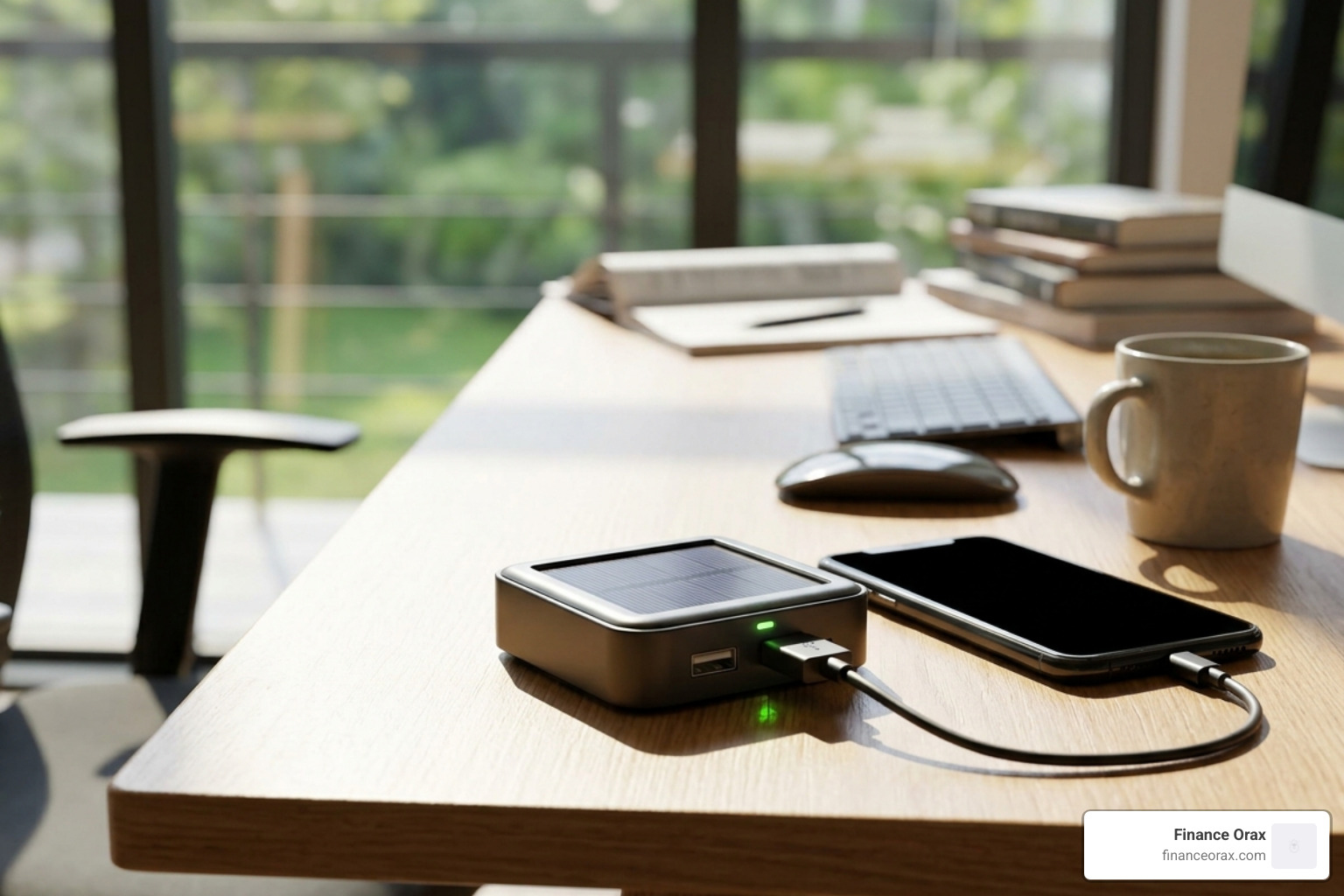
Another standout is the DENVIX PowerX, which balances high capacity with a compact form factor. For those who want a permanent outdoor/indoor transition, the Solar Workstation and Charging Bench | Scandik by Archasol offers a glimpse into high-end setups. These workstations utilize 200W monocrystalline arrays and large gel batteries (up to 75Ah) to provide a reliable emergency power backup for your entire desk setup.
By using a hybrid system, you get the best of both worlds: the ability to charge via a wall outlet before a big workday and the peace of mind that sunlight will keep your essentials running during a power outage.
Safety, Build Quality, and Sustainability
When you are leaving a device in the sun all day, build quality isn’t just about looks—it’s about safety. High-quality solar powered desk chargers are built with intelligent device recognition and four-stage battery management. This prevents overcharging, short-circuits, and the overheating that can occur when lithium batteries sit in direct sunlight.
Look for these quality markers:
- Marine-Grade Polymers: These materials are UV-resistant and won’t become brittle or discolored after months on a sunny windowsill.
- Powder-Coated Steel: Found in more permanent desk setups, this provides durability and heat dissipation.
- TSA Compliance: If you plan to take your desk charger on the go, ensure the battery is under 100Wh (roughly 27,000mAh at 3.7V) to meet airline regulations.
- Monocrystalline Efficiency: Always opt for monocrystalline over polycrystalline panels. They are more efficient in smaller spaces and perform better in lower light conditions.
Sustainability is the core of this movement. By choosing products made from eco-friendly materials and utilizing renewable energy, we are making a micro-contribution to a larger goal. Even a small solar charger on a desk can save several pounds of carbon emissions over its multi-year lifespan.
Frequently Asked Questions about Solar Desk Charging
Can a solar charger work through a window?
Yes, but with a catch. Modern windows often have UV-filtering coatings (Low-E glass) designed to keep heat out. This can reduce the efficiency of your solar powered desk charger by 30% to 50%. For the best results, place the charger as close to the glass as possible or, if safe, on the outside of the window.
How long does it take to charge a 50,000mAh power bank via solar?
If you are relying solely on the small solar panel built into the top of the power bank, it can take 100+ hours of direct sunlight to reach a full charge. This is why we recommend “hybrid” use: charge it from the wall first, then use the solar panel to maintain that charge throughout the week as you top off your phone.
Are solar desk chargers safe for high-end laptops?
Absolutely, provided they have proper voltage regulation. Look for chargers that support USB-C Power Delivery (PD). This protocol allows the laptop and the charger to “talk” to each other, ensuring the charger only sends the exact amount of power the laptop can handle.
Conclusion
At Finance Orax, we believe that the best daily routines are built on a foundation of smart, sustainable choices. Integrating a solar powered desk charger into your workspace is more than just a tech upgrade; it’s a commitment to a more intentional way of living.
By combining practical eco-friendly advice with high-quality decor and setup ideas, we help you create a home office that doesn’t just look good—it works for you and the planet. Whether you choose a sleek integrated table or a powerful hybrid station, the sun is ready to power your next big idea.
For more tips on building a better daily routine and optimizing your home office setup, visit us for more info about routine-building services.
